
This initial version of the Chronicle of the UCSD Gaza Solidarity Encampment is aimed at creating a basic accounting of what happened at UCSD on the days May 1-6 and at pushing back against the lies, misrepresentations and anti-Palestinian and anti-Arab racist tropes and anti-Muslim bigoted tropes that the UCSD senior administration has used to justify their violent dismantlement of the Encampment, based on published accounts and our own experiences. We anticipate that this version will initiate a conversations that have been suppressed by the UCSD senior administrations implementation of the Palestine Exception to Free Speech.
In future versions, we plan to incorporate text, image, video and art contributions from a broader array of organizers, members, participants, and supporters of the Encampment.
Version 1.1 is planned for December, 2026. Click here to participate.
Three Ways to Read The Chronicle
1) Download the full Chronicle of the UCSD Gaza Solidarity Encampment Versions 1.0 in pdf format.
2) Read Each Section of the Document - See the Table of Contents below for the links
3) Read the Full Document below.
Table of Contents
Introduction
On May 1, 2024, University of California - San Diego (UCSD) students established a Gaza Solidarity Encampment along Library Walk, adjacent to Geisel Library. It was a space of research, education and community engagement about the genocide in Gaza, the occupation of Palestine, and UCSD’s complicity in both.
Contexts of the Encampment and Aftermath
The UCSD Gaza Solidarity Encampment can be understood within three contexts: the settler colonial university, the legacy of student protest on campus and the Palestine Exception to Free Speech.
Our Methods: How We Chronicle the Story of the Encampment and Deconstruct the 'Fact Sheet'
Our methodology is motivated by radical ethnography, militant ethnography] and aspiring to position ourselves as "accomplices" rather than "allies" in the struggle to end an occupation and a genocide].
Retelling the Stories of the UCSD Gaza Solidarity Encampment
We describe the Encampment through a series of lenses, ways of viewing and experiencing this transformative physical and discursive space.
Summary Timeline of the UCSD Gaza Solidarity Encampment
The following timeline recounts key moments of this rich, multidimensional space and, in parallel, in Gaza.
Notes on the Senior Administration's 'Fact Sheet'
To manufacture consent and justify their violent dismantlement of the Gaza Solidarity Encampment, UC San Diego senior administration employs coded language and racist, anti- Muslim bigoted tropes which parallel rhetoric that has long legitimated violence against Palestinians and Black People in the U.S.
Chronicle of the UCSD Gaza Solidarity Encampment (Version 1.0)
Introduction
On May 1, 2024, University of California - San Diego (UCSD) students established a Gaza Solidarity Encampment along Library Walk, adjacent to Geisel Library. It was a space of research, education and community engagement about the genocide in Gaza, the occupation of Palestine, and UCSD’s complicity in both. 1 The Encampment featured 1) teach-ins; 2) a library; 3) research on UCSD’s ties to genocide; 4) community speakers; 5) Fandango, Dabka dancing, Shabbat ceremony and Muslim prayer; 6) sharing meals; and 7) Palestinian-Jewish student collaboration. 2, 3, 4
The goals of the encampment addressed UCSD’s complicity in the genocide: 1) End the silence/permit speech on Palestine; 2) Boycott universities and corporations complicit in the genocide; 3) Amnesty for all who had been affected by the weaponization of disciplinary procedures to silence speech on Palestine and the genocide; and 4) Divest from genocide- supporting corporations and Israeli universities. 5
At the time of the establishment of the Encampment there had been 35,000 Palestinians killed in Gaza, almost 80,000 injured, many with limbs amputated, 24 out of 36 hospitals were not functioning and the other 12 were partially functioning, 1.7 million people were internally displaced, 1.1 million people faced catastrophic levels of food insecurity, all universities in Gaza had been bombed and were not operating, and over 100 university professors had been martyred. 6
Genocide is the ultimate form of racism and anti-Muslim bigotry. 7 The Encampment itself was a rejection of that naked racism and UC support for it. As such, the Encampment was the embodiment of UCSD's Principles of Community, specifically the commitment to rejecting “...acts of discrimination based on race, ethnicity, sex, gender identity, age, disability, sexual orientation, religion, and political beliefs, and, [confronting] and appropriately respond[ing] to such acts.” 8 The Encampment rejected the murder and mass slaughter of people in Palestine at the hands of the US-funded Israeli government, facilitated in part by UC research. 9, 10 It rejected the University of California’s investments in the weapons manufacturers that made the genocide possible. 11 For five days, Encampment members bravely stood together to call attention to, reject, and call for action against the genocide in Palestine and UC’s investment in it.
The immediate context for the UCSD Encampment was a string of major Encampments across the U.S. in solidarity with Palestinians in Gaza undergoing a genocide, starting with an Encampment formed at Columbia University on April 17, 2024. In a statement released by Columbia University Students for Justice in Palestine and the NYC Palestinian Youth Movement on that day, “We set up this encampment today because Columbia University has continually refused to listen to the student body when we demand that they divest from the ongoing genocide in Gaza.” 12 UCSD’s Encampment was the 107th Gaza Solidarity Encampment in the U.S. 13
Our goal is to present the Encampment as we — members, participants and supporters — observed and experienced it: as a necessary, just space that protested against and persisted in the face of UC San Diego's violent complicity in genocide. Unlike the senior administration's account of the Encampment in their 'Fact Sheet,' which falls short of capturing anything about what actually occurred within the Encampment because of their failure to meaningfully engage with it, our telling of the story reflects the pain, the joy, the relationality, the conviviality, the research, the education and the community formation that permeated that space.
This document includes a discussion of the contexts for the Encampment (the settler colonial university, the legacy of campus protest and the Palestine Exception) and its aftermath, the methods we employ, our retelling of the stories of the Encampment, an Encampment timeline, and a critical analysis of UCSD senior administration’s ‘Fact Sheet’. As scholars, we have made reference to supporting citations where possible, and hope that this document will contribute to archiving what happened at the Encampment and its place in the history of UCSD and in the global Palestine Solidarity Movement. As anti-Muslim bigotry and violence only intensifies — most recently, in the appalling attack on the Islamic Center of San Diego — we must reflect on what our Encampment was, and how it still points to a future for justice and the liberation of Palestine.
Contexts of the Encampment and Aftermath
The UCSD Gaza Solidarity Encampment can be understood within three contexts: the settler colonial university, the legacy of student protest on campus and the Palestine Exception to Free Speech. In this section, we examine each context in detail before reflecting on the aftermath of the Encampment.
The Settler-Colonial University
San Diego shares a settler colonial foundation with universities in Israel. UCSD was built upon the Land of the Kumeyaay village Ystagua, which was ethnically cleansed by a succession of military bases, following which the Land was given to the state. 14 In much the same way, Hebrew University in occupied East Jerusalem was in part built upon stolen Land from the Palestinian village of Isawiya 15, and Tel Aviv University was built upon the Palestinian village Sheikh Muwannis, which was ethnically cleansed in the Nakba during March 1948. [16 Hebrew University and Tel Aviv University host military troops and institutes, and conduct research and engage in education that support the genocide in Gaza, and the occupation of and apartheid in Palestine, from the River to the Sea. 17 UCSD conducts military research that benefits the hardware and the technology that supports genocide in Gaza. 9 UC invests in companies that provide critical support for the genocide. 10These disturbing parallels make research, education and community engagement regarding Palestine of central importance to each and every person at UCSD - students, staff, faculty and administrators.
Israeli Universities and their counterparts in the US provided the material and discursive support to the occupation military to destroy every university in Gaza and murder or imprison many beloved Palestinian professors 17, 18, 19, including Distinguished Professor Sufian Tayeh, materials physicist and president of the Islamic University of Gaza, murdered with his family on December 3, 2023 20, and Khitam al-Wasifi, department chair at The Islamic University of Gaza, biophysicist and powerful advocate for women in physics, murdered with her husband also in December 2023. 21
The History of Protest on Campus
The UCSD Gaza Solidarity Encampment also occurred in the context of a rich history of protest and encampments over the course of UCSD’s history. Out of numerous examples, these five cases illustrate the central importance of protests to UCSD’s evolution as a university, even those protests that contravened university policies and state and municipal statutes.
1) In Spring quarter of 1985, students at UCSD constructed a Shantytown on Revelle Plaza, which at the time was an important center of campus life, to visually illustrate the conditions under which Black People in South Africa were forced to live under apartheid. They occupied, completely took over and slept in the Humanities Library in Galbraith Hall for over a month. At no point did the university send in hundreds of police in riot gear to remove students. Instead, UCSD and UC administration learned from the student movement and the following year divested from companies doing business with and within South Africa. Both Nelson Mandela and Bishop Desmond Tutu, leaders of the movement against apartheid within South Africa, acknowledged the central role of U.S. student movements in ending apartheid in South Africa, a fact that the UCs now use in promoting themselves. 22, 23, 24, 25
2) Starting in the 1970s, Women on the UCSD campus were organizing and advocating for a Women’s Center (the Women’s Resource Center student organization) – in response to the prevalence of misogyny on campus and the need for dedicated services and support. In the early 1990s, UCSD was the only UC campus without a Women’s Center. So in 1992, Women students and their allies constructed a Women’s Center, in the form of an Encampment, on Sun Goddess Lawn that operated for a week, providing services to Women and serving as a source of information to all about misogyny on campus. They were modeling what a Women’s Center would look like. No arrests were made and no police in riot gear invaded the campus. Following the Encampment, senior administration began to seriously consider proposals for a Women’s Center. Plans were approved in 1995 and the Women’s Resource Center opened in its current location in 1996. 26, 27, 28
3) In February of 2010 – Black History Month – a UCSD fraternity held an anti-Black, racist frat party, which the fraternity called the Compton Cookout, where they invited attendees to dress up as racist stereotypes of people who lived in Compton. The party was followed by numerous racist incidents in the coming weeks that echoed the terror of the Jim Crow era, including using the N word on UCSD-TV, placing a kkk hood on the Geisel statue and hanging a noose in Geisel Library. Black and Brown students at UCSD organized almost daily rallies, they blocked Library Walk completely numerous times, they occupied the chancellor’s office, which used to be located just off of Library Walk, for a day. They occupied the Price Center West courtyard for a morning and the Price Center East steps for an afternoon. No detentions occurred, no police in riot gear were called and no disciplinary investigations were initiated. In fact, the senior administration – Chancellor, Vice Chancellors, Provosts and Divisional Deans – held extended meetings with representatives of the Black Student Union and MEChA. The senior administration agreed to a set of demands made by the Black Student Union, These demands included requiring a DEI course for all undergraduates, creating the Black, Raza and Intertribal Resource Centers, creating the position of Vice Chancellor for EDI and returning the Kumeyaay remains. In summary, the campus significantly changed for the better as a result of student organizing and the responsiveness of the senior administration to that organizing. 29, 30, 31, 32, 33, 34, 35
4) In response to continuing inequality and sexual harassment of Women at UCSD, in 2015 students organized a Free the Nipple protest in which dozens of Women and Men, both cis and trans, bared their breasts on the Price Center lawn adjacent to Library Walk, located across from the site of the Gaza Solidarity Encampment. 36, 37 The students visually created an explicit picture of what equality looks like. That protest connected with forerunners of the MeToo movement and Trans Advocacy on campus. No arrests were made, no disciplinary investigations were conducted. As ABC 10 News put it at the time “Typically, nudity in public spaces violates San Diego municipal codes and the UCSD student code of conduct, but the school told 10News they support the students and their First Amendment rights.” 38
5) During the UAW graduate student strike of 2022, student organizers created a two-week tent Encampment in Muir Quad. It visually illustrated the impact of substandard wages on graduate students, many of whom were not able to afford a place to live. The Encampment, which the students called Khoslaville, was not raided, it was not violently dismantled and students there were not detained nor subject to disciplinary procedures. One result of the strike was a better approximation to a living wage for graduate student workers at UCSD and all the UCs. 39
Many more examples could be cited, but in these five cases students connected injustices with global impact to actions that could be taken on the UCSD campus. The senior administration met with, listened to and/or learned from student organizing, and UCSD became a more open, a more welcoming and a better campus because of student organizing.
The Palestine Exception to Free Speech
The Encampment also occurred in the context of repression of expressive activity regarding the genocide and occupation of Palestine, and repression of discussion of the violence of the genocide and occupation in classrooms during the period October 2023 – April 2024. This repression was facilitated through messaging sent out from official channels. Numerous students who were organizing protests were ensnared in student misconduct processes.
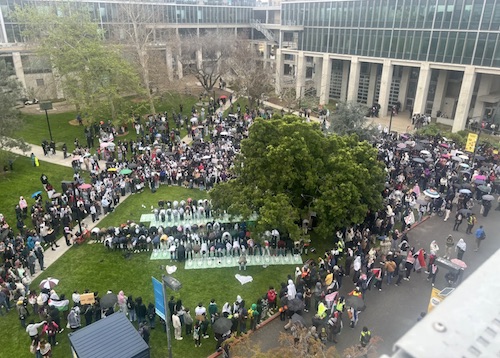
Despite the repression, students organized a number of rallies and marches, including one on March 6, 2024 with more than 2500 students, staff and faculty -- one of UCSD's largest protests. 40 Faculty who discussed the genocide or the history of ethnic cleansing in Palestine in class were unjustifiably put under investigation for anti-semetic hate speech. These actions by senior administration created a situation where students, faculty and staff felt there was no safe place to discuss the genocide. This repression of speech about the genocide and Palestine was one of the motivations for establishing the Encampment at UCSD.
Free speech is not fundamentally a legal construct, it is grounded in struggle and practice in the streets. An illustration of this distinction can be found in the Free Speech fights in San Diego in 1910-12, where members of the Industrial Workers of the World (IWW) labor union set up literal soapboxes on street corners and attempted to speak from there, enacting the ability to speak in public locations that were conducive to collective organizing. Police responded by beating and spraying workers with firehoses and arresting them. Vigilantes, tolerated and encouraged by the authorities, kidnapped prominent organizers and literally covered them with hot tar and rolled them in feathers. 41 The vigilante attack on the UCLA Encampment on April 30, 2024, where security and police stood back and allowed the violent assault to occur for four hours, and the violent dismantlement of the UCLA Encampment the following day recall the police-vigilante collaboration in suppressing speech in San Diego in the early twentieth century. 42, 43
Scholars and legal experts refer to the repression of speech about Palestine as the Palestine Exception to Free Speech. 44 This repression is rooted in anti-Palestinian and anti-Arab racism and anti-Muslim bigotry. 45, 46, 47, 48
Aftermath
In the early morning hours of May 6, 2024, as birds in the eucalyptus trees were singing and students were sleeping, and as the Israeli Occupation Forces were beginning a genocidal ground attack on Rafah, a force of over 200 police dressed in riot gear invaded the UCSD campus, violently dismantling the Gaza Solidarity Encampment and arresting 64 students, faculty and community members. 49 This assault on our campus, ordered by Chancellor Pradeep Khosla, caused physical and psychological trauma that echoes to this day. The Council on American-Islamic Relations (CAIR) declared UCSD to be a hostile campus for Palestinian, Arab and Muslim students 50, 51. To quote from the analysis of Students for Justice in Palestine at UC San Diego:
When you unleashed a heavily armed police presence on our campus, you send a clear message: dissent is not welcome here. You criminalized our peaceful assembly, characterizing students who sought to raise awareness of an ongoing genocide as threats to be subdued. The brutal tactics you employed that day – batons, pepper spray, snipers and threats – were not just violations of our rights, they were a betrayal of the university’s foundational values of free expression and intellectual inquiry... 52
Almost exactly two years later, UCSD’s role in suppressing speech about the genocide and its hostility to Islam contributed to an elite-validated climate in San Diego that enabled the attack on the Islamic Center of San Diego on May 18, 2026, in which three valued members were murdered. Amin Abdullah, Mansour Kaziha, and Nadir Awad prevented the attackers from getting to school children and Center personnel that horrible morning. 53 Graduate student in Ethnic Studies and Critical Gender Studies Muhammad Yousef summed up these dangerous connections between racism and violence, in this context, writing in the UCSD Guardian:
“The murders of Amin Abdullah, Mansour Kaziha, and Nadir Awad were neither unavoidable tragedies nor mere accidents but the direct result of hegemonic social structures and cultural representations which position Muslims as simultaneously violent and killable. Former drone engineer and current Chancellor Pradeep Khosla decried the shooting as “senseless.” But is it? Islamophobic violence is not beyond comprehension — it operates by its own logic and produces its own common sense, propelled by discrete material forces. So, to me, nothing about this latest tragedy is “senseless.”” 54
At the vigil honoring the martyrs on May 20, Omar Abusham of CAIR San Diego spoke of the need for accountability at UCSD, that the foundation for events like the violent attack on the Islamic Center is anti-Muslim bigotry and anti-Arab racism, which UCSD senior administration and others such as the mayor of San Diego have fostered since October 2023:
"Concerns of the MSA [Muslim Student Association] have not been addressed on multiple occasions; I know that there was an Islamophobic display that was on campus only last week. These words are not just words, and we saw that on Monday. These words turned into action and this action led to the killing of three amazing individuals.” 55
When will Chancellor Khosla and the senior administration be held accountable for refusing to meet with the MSA during the 2024-2024 academic year? 56 The senior administration and the UC Regents have insisted that students and faculty arrested at UC Encampments be held accountable through seemingly endless disciplinary processes. When will Chancellor Khosla and the senior administration responsible for implementing the Palestine Exception at UCSD be held accountable for their actions? For their material and discursive support for genocide? For their suppression of speech about Palestine and the genocide? For their violent reaction to the UCSD Gaza Solidarity Encampment - an entirely peaceful protest well within the tradition of protest at UCSD? For their unlawful use of university funds to pursue their political agenda and the agendas of their donors and political allies? For their despicable contribution to the hateful environment that produced the Islamic Center of San Diego shooting and will produce further racist violence that is sure to occur in the future?
Our Methods: How We Chronicle the Story of the Encampment and Deconstruct the 'Fact Sheet'
Our methodology is motivated by radical ethnography 57, militant ethnography 58 and aspiring to position ourselves as "accomplices" rather than "allies" in the struggle to end an occupation and a genocide 59. We strive to be accomplices, not mere allies in the movement for the liberation of Palestine, because “The risks of an ally who provides support or solidarity (usually on a temporary basis) in a fight are much different than that of an accomplice. When we fight back or forward, together, becoming complicit in a struggle towards liberation, we are accomplices.” Our work is rooted in the needs of the Palestinian people and all Indigenous peoples and their right to self-determination and liberation. Throughout our archival work, we honor and move at the speed of the most vulnerable in order to challenge colonial logics and genocide. “Accomplices listen with respect for the range of cultural practices and dynamics that exists within various Indigenous communities. Accomplices aren’t motivated by personal guilt or shame, they may have their own agenda but they are explicit." We work collectively to ground our documentation in ways that bind us together in humanizing ways. "Accomplices are realized through mutual consent and build trust. They don’t just have our backs, they are at our side, or in their own spaces confronting and unsettling colonialism. As accomplices we are compelled to become accountable and responsible to each other, that is the nature of trust." 59 As we struggle in hostile university spaces, we seek to confront the deeply foundational colonialism at the heart of the University of California 60 and its current manifestations, from the continued occupation of stolen Indigenous Lands to the violent dismantlement of Gaza Solidarity Encampments at UCSD, UCLA, UCI, UCSC and UCSB. Our approach of periodically creating new versions of this document allows us to consult with and connect to communities struggling for a free Palestine, at UCSD, across the UCs, within the global solidarity struggle and with those on the frontlines in Palestine, while retaining the responsibility for the work of producing and modifying this document locally.
We employ radical ethnography in foregrounding the narratives of life experiences and circumstances of the members of the Encampment. We center personal narratives as invaluable, challenging the objective/subjective bias that tends to elevate official state- sponsored narratives over the narratives of participants in the Encampment. We quote extensively and reproduce images as a way of centering self-determination. The political and historical context of the Encampment grounds our work to document stories of the Encampment. As Encampment members, participants and supporters ourselves, we reject the duality of researcher/researched and listen, observe and learn from participants to disrupt these socially constructed roles. We resist the temptation to impose regular, universal patterns on an Encampment composed of diverse, multifaceted members, in a manner that typifies traditional ethnographic methods, and instead aim to follow “breaks, incongruencies and ruptures.” Last, we expand the audience of our chronicle beyond the academic scholarly community, because a genocide's harms extend broadly, and what the Encampment story offers us is a way to re-humanize Palestinians and to stop a genocide. 57
As activists engaged in scholarly work, militant ethnography offers us a framing to engage as researchers as we work to end a genocide and learn from our activism to improve our practice. Under this framing, we are both politically active and collaborative in both our activism and research. 58 Our chronicle allows us to draw upon our own experiences as valuable: "“This tendency to position oneself at a distance and treat social life as an object to decode, rather than entering into the flow and rhythm of ongoing social interaction, hinders our ability to understand social practice." Last, this chronicle allows us, members of the Encampment and activists for a free Palestine, to learn from our Encampment to improve our activism: "In this register, ethnography becomes a tool for collective reflection about activist practice and emerging utopian imaginaries." 58 We envision a free Palestine and liberation and self-determination for all Indigenous peoples.
Our data include timelines and descriptions of events from social media, photographs and video, published descriptions of the events in letters, commentaries and news stories, documents, and our own and participant observations, recollections and oral histories all integrating what happened and its context. Additionally, we aspire to describe how the Encampment impacted bodies and minds, in the sense of Dian Million's Felt Theory 61. We seek to document the secondary, aftershock trauma of a genocide, the baton blows and and the endless authoritarian hammer that follows those in the global solidarity movement for a free Palestine who color outside the lines, as well as the revolutionary joy that are inscribed in bodies and minds, as the trauma and occasional joy are to a much greater extent etched in the bodies and minds of those on the frontlines. In this first version, we only scratch the surface of this important aspect of UCSD's Encampment, which we plan to explore further in subsequent versions.
Our analysis of data and artifacts seeks to develop a fluid and politically grounded narrative that upends the colonial logics of a police state that tries to but always fails to destroy the movement for a free Palestine.
Retelling the Stories of the UCSD Gaza Solidarity Encampment
In this section, we describe the Encampment through a series of lenses, ways of viewing and experiencing this transformative physical and discursive space:
1) the physical layout and functioning of the Encampment;
2) the Encampment as a place of education and research about the genocide and the settler colonial occupation of Palestine and UCSD's complicity in both;
3) The Encampment as a place to advocate for change at UCSD;
4) The Encampment as a communal space of mutual support;
5) The Encampment as a space for communicating the pain and horror of the genocide and the possibilities for liberation, in Palestine, at UCSD and elsewhere, to the UCSD community and to media via signs, chants, interviews, etc.;
6) The Encampment as a place for discussing, practicing and sharing diverse cultural and religious traditions; and
7) The Encampment as an organizing space under pressure - from senior administration hostile messaging, from police and security, from surveillance and from counter-protesters - requiring a very high level of discipline, communication and organizing among its members, a space ultimately violently dismantled on May 6.
1) Physical Layout
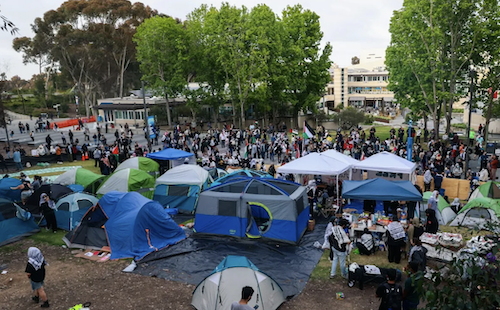
We begin with an overall view of what the Encampment was like, from our perspective. The physical layout of the encampment on May 1, as seen from a news helicopter, can be viewed to the right 62. (The three pop-up tents in the foreground on Library Walk were not affiliated with the Encampment.)
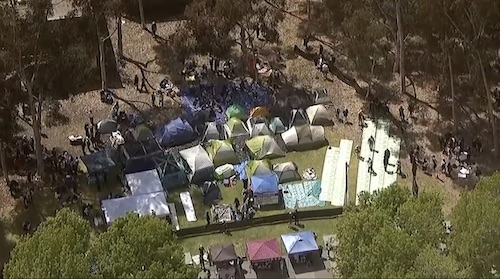
The encampment was located on an unused area of grass, wood chips and soil adjacent to Library Walk, which often is referred to as UCSD's Town Square. This location allowed students their right to expression at a place easily visited by the community, but also not interfering with students, staff and faculty going about their day amidst a genocide. The construction of the Encampment was quiet, swift and organized, marking clear boundaries and an entrance.
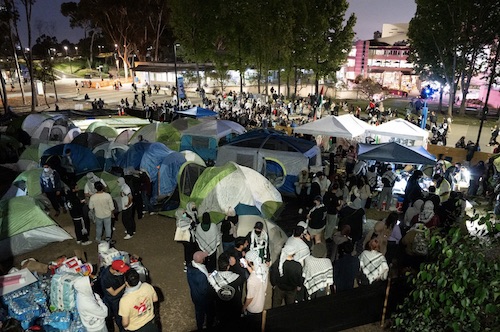
The Encampment footprint was outlined with black plastic tarp material strung between wooden stakes. Prayer rugs for Muslim prayer were located at the north end of the Encampment (towards Geisel Library). The eastern boundary of the Encampment was about 15 feet from Library Walk. This boundary contained signs, banners, photos from Palestine, and displays, neatly arranged and all easily visible from Library Walk. At approximately the center of this boundary was a speaker's canopy from which teach-ins, lectures and other events were conducted. Meeting canopies and tents, a medics tent and other communal spaces were located in the middle, west from the the eastern boundary structures, and residence tents generally were located at the west end of the Encampment. A kitchen and food distribution area was near the back of the Encampment, with tables, sanitation, and a set-up allowing for food safety protocols to be easily managed.
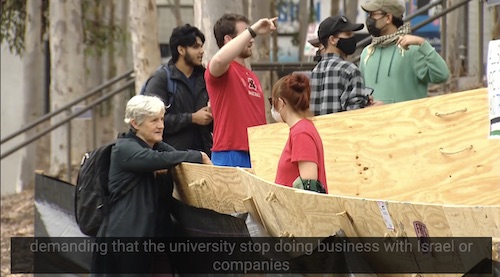
Initially, the Encampment entrance was located at the southeast corner of the Encampment. The entrance was moved to the northeast corner of the Encampment to facilitate security. Volunteer security personnel were located around the periphery of the Encampment 24 hours per day to ensure the safety of those inside and outside the Encampment.
In addition to daily planned activities, speakers and prayers, students, faculty, families and children came to visit and learn at the Encampment. Members of the Encampment came to the perimeter to talk with visitors about their protest, demands and the devastating statistics of the genocide's destruction of precious life, land, histories, and futures. 63

2) Education and Research
The student-organized Encampment was a space where intense agony and grief were turned into peaceful action. It was a site of education, research and community engagement about the genocide and its connections to the students’ university, thereby contributing to the mission of UCSD. The point was not to get arrested, but rather to carry out educational, research and community engagement actions that the senior administration was actively trying to suppress; the Encampment was not civil disobedience, it was direct action with specific demands. Likewise, signs reflected these demands, some concise and clear in their call: "Stop Arming Israel."
Throughout the duration of the Encampment, faculty gathered at the cement blocks outside of the northeast corner of the Encampment. Faculty used this location as a meeting place to share conversation, make zines, and to prepare for, practice and provide teach-ins. On May 6, eighty-six UCSD Faculty who visited the Encampment (also endorsed by 160 faculty who did not) testified that “the encampment was a beautiful community space; for some of us the most beautiful community, cultural and educational space we have ever seen in several decades at UC San Diego.” 64 Faculty were carrying out UCSD's Principles of Community that expect faculty to protect students and to “reject acts of discrimination based on race, ethnicity, sex, gender identity, age, disability, sexual orientation, religion, and political beliefs”. The Principles go even further, urging community members to “confront and appropriately respond to such acts.” 65
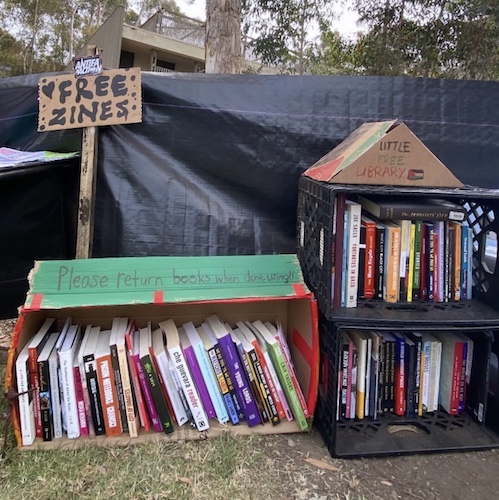
Making it clear that the Encampment was meant to be a collaborative and open educational space, faculty, students, and community members set up a "little free library" with a sign that directed borrowers "Please return books when done using!!"
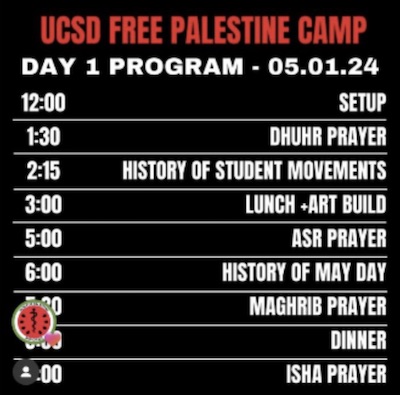
Faculty and community leaders came to the Encampment to educate students on topics such as the surveillance state and political strategy. 67, 68 For example, the Day 1 program included teach-ins on the history of student movements and on the history of May Day.
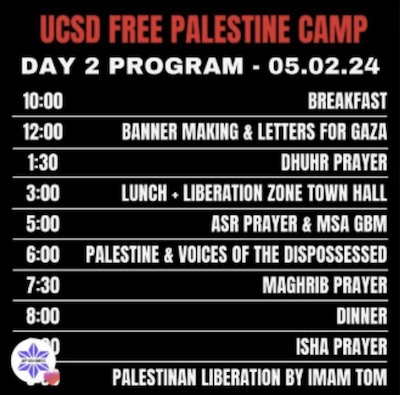
These history lessons were also posted on the Instagram account of Students for Justice in Palestine at UC San Diego, offering a place for additional study of primary sources of the history of student movements at UCSD, for example, see for example, Figure 6.
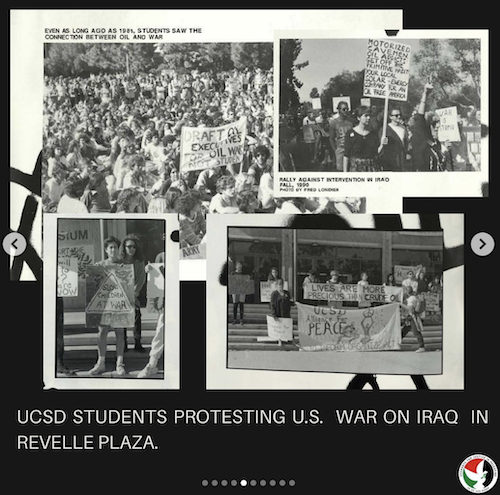
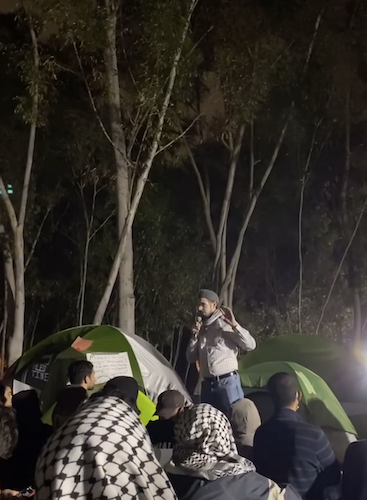
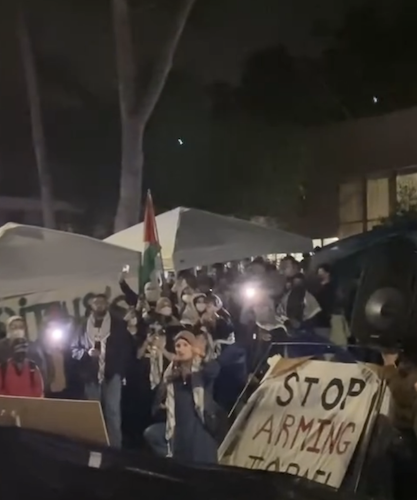
Research was a mainstay at the encampment. Members of the Encampment, under the banner of the UCSD Divest Coalition 69, researched UCSD's complicity in the genocide, focusing both on research that enables the genocide, such as through the Scripps Center for Marine Archeology, the Institute on Global Conflict and Cooperation, the Rady School's US- Israel Center and weapons research at the Jacobs School of Engineering 70, 71 and also on investments that fund the genocide. 72
The Encampment was necessarily a fast-paced and reflective learning environment. Not only did organizers need to create an autonomous Encampment that housed, fed, and cared for the physical and emotional needs of the members of the Encampment, but they also had to carry out research, follow breaking news, train media liaisons, give interviews, make social media posts, make decisions about next steps and carry on with their studies, jobs and other responsibilities, to name just a few. Students had to be able to articulate to people with differing levels of knowledge about the genocide in Palestine, what the Encampment was demanding and why. This required knowledge of the history not only of Palestine, but also of the statistics and political history of the region. They had to attend to and research USCD's investments, financial structure, and complex entanglements with a genocidal state's networks of partnerships and investments in UCSD. All of this was done under the strain of the increasing number of Encampments across the US being violently raided by police.
3) Advocating for Change at UCSD
The context of UCSD’s Gaza Solidarity Encampment, a peaceful student-organized protest, was the genocide of the Palestinian People in Gaza and UCSD’s complicity in it. On May 1, 35,000 people in Gaza had been killed. The deaths, the horrific injuries, the rubblization of homes, businesses, schools, universities and hospitals, the murders of professors, medical professionals and journalists, the denial of water, food and medicines, the incessant buzzing of drones, all of this was live-streamed and documented 24/7 on students phones in heart- wrenching video and images of death, suffering and destruction.
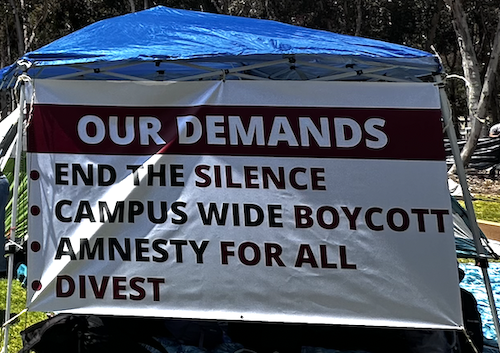
The goals of the Encampment were prominently displayed on a banner "Our Demands" at the east side of the Encampment. The goals of the Encampment addressed UCSD’s complicity in the genocide:
1. End the silence (Affirm Palestinians' right to life and safety, condemn the ongoing genocide in Gaza, and call for the permanent immediate ceasefire);
2. Campus-wide boycott (Permanently sever all institutional ties to Israel and other entities that render our university complicit in the Gaza genocide, including research partnerships with the Israeli Defense Ministry, U.S. Department of Defense, and private defense contractors);
3. Amnesty for all (Ensure amnesty for all those associated with the Gaza solidarity encampment at UCSD, and stop the repression of Palestinian activism on our campus);
4. Divest from death (Immediately divest the University of California's financial holdings from weapons manufacturers and companies that enable and profit from Israeli apartheid, occupation, and genocide. 73
More than two years after the Encampment, and even in the wake of the Islamic Center of San Diego attack and murders 74, the first demand remains unfulfilled and the silence continues. UCSD senior administration has not spoken out in support of its Palestinian, Arab and Muslim students nor has it condemned a genocide that has destroyed all universities in Gaza and murdered more than 100 Palestinian faculty.
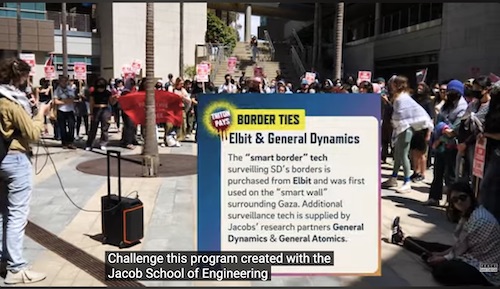
Because the Encampment was cut short by the violent attack ordered by UCSD senior administration, research on UCSD's research that materially and discursively has supported the genocide in Gaza was not shared until the UC-wide strike by graduate student unions that followed the violent Encampment dismantlements at UCLA, UCSD and UCI. The findings were presented in a UCSD Complicity Walking Tour on June 3, 2024. 75 The second demand, a campus-wide boycott, remains unaddressed. Research in support of the genocidal killing machine continues at UCSD, and research ties remain.
Rather than address the third demand asking for amnesty for all, the senior administration has doubled down on their aggressive implementation of the Palestine Exception to Free Speech through the politicization of legal and disciplinary processes, beginning in 2024 and continuing to the present (August, 2026). They advocated that all those arrested at the Encampment on May 6 be criminally charged, but the City Attorney declined to do so. 76 They put all 56 students arrested at the Encampment through lengthy student misconduct procedures in processes that have been characterized as kangaroo courts or show trials. The university presented generic, non-specific identical evidence packets for all the students, and despite excellent pro-bono representation, all but one student was found guilty. 77 Almost two years after the Encampment, the senior administration brought disciplinary charges against two faculty members who stood with their students during the violent police raid on the Encampment. 78 Those processes are still ongoing. Additional disciplinary charges for Palestine advocacy have been brought against both students and faculty, and no charges have been brought against anyone participating in anti-Palestinian advocacy, contributing to a chilling effect on academic discussion of the genocide at UCSD.
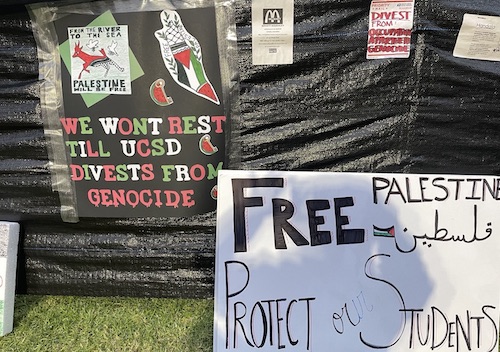
Regarding the fourth demand on divestment, the UC Regents have repeatedly refused to divest from Israel (e.g., 79). In 1986, the UC Regents divested from South Africa because of its implementation of the crime of Apartheid, following intense student pressure. 80 Forty years later, the current UC Regents refuse to divest from Israel for the more serious crime of genocide in Gaza.
UCSD's partnerships with Israeli universities, US Department of Defense contracts, investments in war, and how these make all people unsafe were the topics of many signs, large and small.
Throughout the Encampment students from inside and outside of the Encampment led anti-genocide chants, the most often recited was a simple and righteous demand through call and response: "Free...Free Palestine. Free! Free! Free! Palestine!" Chanting served multiple purposes: to express a collective message, build solidarity, sustain energy and morale, attract public attention, make participation accessible, coordinate collective action, and create memorable narratives. All of the chants distilled the dimensions of the movement for a free Palestine into concise, memorable phrases. These chants communicated the Encampment's demands and values to bystanders, fellow students, the media and decision-makers. For example, "Khosla, Khosla, you can't hide! You are funding genocide!" coveys a clear message that UCSD Chancellor Khosla's administrative decision- making provides the financial backing for and repression of student speech about Israel's continued genocide of the Palestinian people. Similarly, "UCSD, you can't hide, we charge you with genocide!" implicates UCSD's furtive partnerships and investments in Israeli universities and weapons development, is a clear call for justice and will long be associated with UCSD's Encampment.
Students were clear about the goals of the Encampment and UCSD's complicity in genocide as KPBS reported on May 1: "'As a Jewish American student, I stand with the many Jewish, Palestinian and people of all backgrounds that demand divestment from the occupation and genocide of the Palestinian people,' said Rachel, an undergraduate majoring in biological anthropology. 'We are inspired by the Black civil rights movement, the anti-apartheid movement in South Africa, and the Jewish concept of Tikkun Olam — to repair the world — to call for a free Palestine.'" 81
Students who participated in the Encampment protest sacrificed their own time, comfort and safety to draw attention to their heartfelt opposition to the genocide in Gaza and to build solidarity. They sustained their energy and morale with chants like, ""Disclose! Divest! We will not stop, we will not rest!" Beyond these reasons, chants also served to make participation in protest accessible to passersby who could also choose to speak out against the genocide through joining in collective chants: "The people united will never be defeated!"
4) Communal Space/Mutual Aid and Support
The UC San Diego (UCSD) Gaza Solidarity encampment operated as a highly organized, self-sustaining communal ecosystem rooted in the principles of mutual aid. Rather than just acting as a site for physical tents, the student-led coalition structured the space near the
Geisel Library to independently meet the daily physical, medical, educational, and safety needs of its participants. Students were aware that they would need to secure their own safety and care through mutual aid. As reported by ABC 10 News on May 2, one member of the Encampment shared, "'Since we've been out here we've received threats that they'll call SDPD, that they'll review our IDs,' Yasmeen said. 'We want to make sure the students are protected and can exercise their rights.'" 82 Yasmeen said she felt like she has to 'be on her toes' because of how closely school officials and security and police officers are watching.
To maintain independence from university infrastructure, organizers established dedicated, fully-stocked resource booths:
● Food and Water Tents: A centralized kitchen area distributed free meals, snacks, and water to anyone inside the Encampment. These supplies were largely replenished by a steady stream of community donations from local San Diego residents and businesses, and supportive faculty members. (Figure 12: 83
● Medical and First-Aid Hubs: The Encampment featured a medical tent staffed by volunteer students and healthcare professionals. It was stocked with basic first-aid kits, over-the-counter medication, hygiene products, and personal protective equipment.
● Sanitation Teams: Dedicated trash and recycling stations were monitored by student volunteers to keep the public area clean and ensure the campsite remained organized and safe.
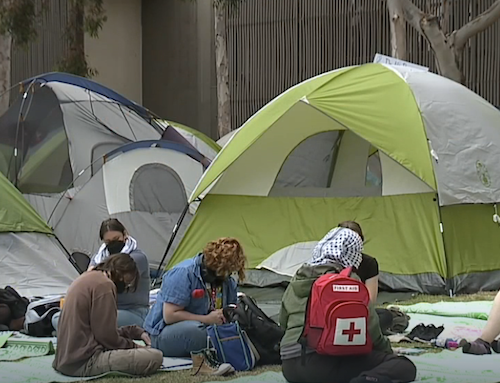
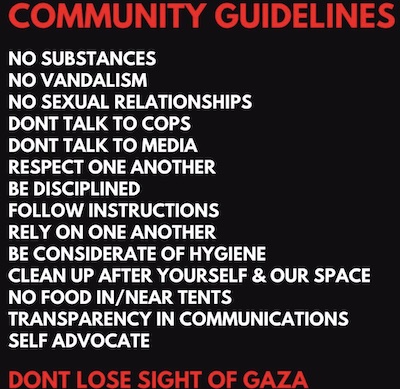
The Encampment implemented autonomous safety protocols. Given that the senior administration fostered hostility toward students who opposed a genocide, members of the Encampment relied on collective internal protocols to keep themselves safe. The Encampment deployed De-escalation and Safety Teams. Student volunteers were assigned to guard the perimeter, teach incoming visitors community guidelines and safety protocols, and practice de-escalation tactics. This ensured that internal community members and participants on the Encampment periphery remained protected from harassment by counter- protesters and administrative staff. Community guidelines were posted and adhered to by all members of the Encampment. The organizing coalition established community behavioral guidelines emphasizing non-violence, cleanliness, mutual respect, and sober participation to preserve the Encampment's focus on peace and solidarity.
The local San Diego community, inspired by the student Encampment, contributed donations including extra blankets for cold nights, and supplies for the well-being of members of the Encampment.
5) Communicating the Pain and Horror of Genocide and The Possibilities for Change
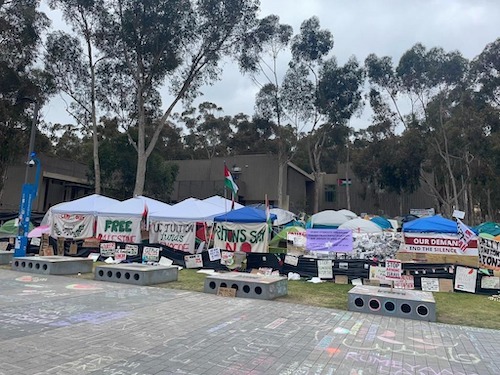
On May 1st and the following days, passersby and onlookers were greeted with the dozens of lovingly designed signs and banners that were placed at the perimeter of the encampment and against tents.
Signs carried clear messages of the deeply held beliefs, some explicitly religious, of the students to end the violence in Gaza. The signs were a living reminder of the hearts and minds of students who had joined a nationwide movement to stop killing and death in Gaza. Their messages reflected a love for all.

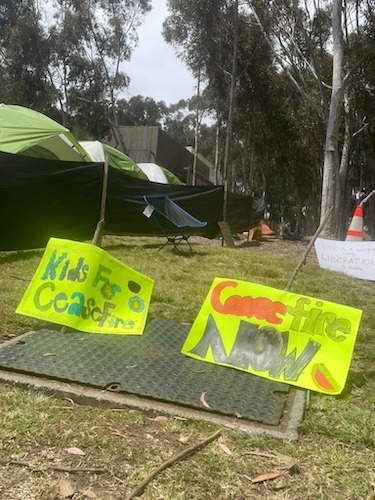
Signs made by youth called for a ceasefire (Figure 16).
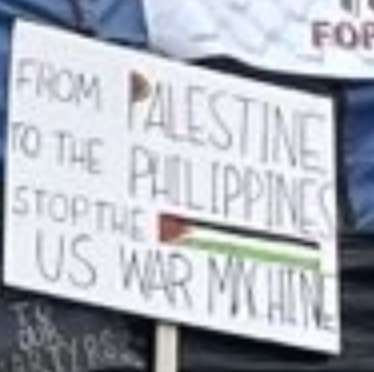
Signs were deeply analytical and named power structures and war profiteering as the root of the genocide: "From Palestine to the Philippines: Stop the US War Machine" (Figure 17).
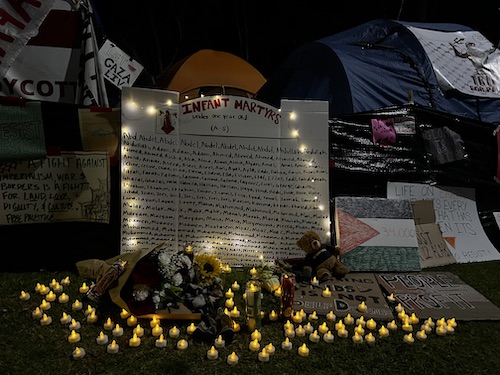
Passersby on Library Walk read signs, took photos of them, and visited the memorial to the infant martyrs murdered by Israel, honored with the placement of small electric candles.
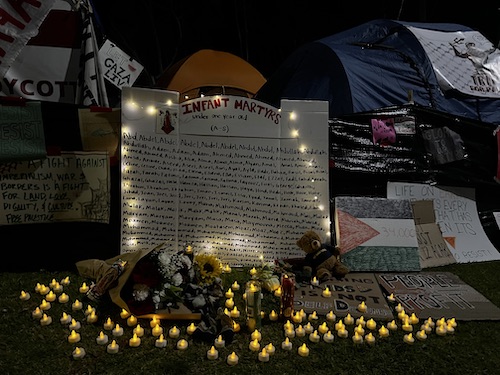
Visitors were observed in contemplation and conversation with one another.
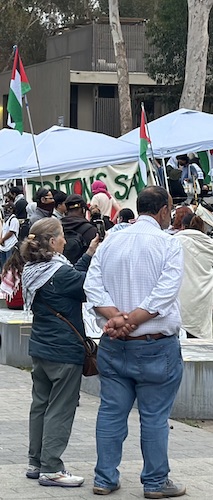
News media came daily to the Encampment to interview and film spokespeople and passersby about the Encampment. 84 Helicopters could be heard and were observed hovering over the Encampment, as were drones. Despite harsh reprisals for peaceful protest observed at multiple UC campuses and nationwide, members of the Encampment persisted, given their belief that the genocide merited the risk their constitutionally protected speech might be infringed upon by UCSD senior administration.
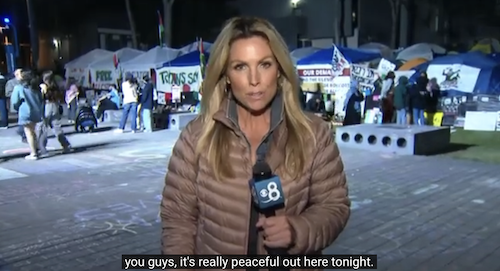
Some media outlets contrasted the violence of the police attack on the Encampment on May 6 with its peaceful nature. For example, Fox 5 News noted "Up until Monday, the encampment had largely remained calm, aside from drawing a group of counter-protestors and health inspectors over the weekend." 85
6) Sharing Diverse Cultural and Religious Traditions
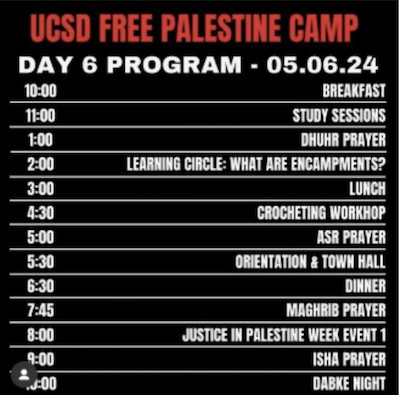
The Encampment was organized through a Palestinian, Arab, Muslim, and Jewish collaboration that drew explicitly on religious and cultural traditions foregrounding justice and freedom from oppression. Throughout the duration of the Encampment, participants, students, faculty, staff, community members, including families and children, shared their diverse cultural and religious traditions, enriching the learning space through an mutual exchange of ideas and deeply held beliefs and practices. The Encampment offered a rare opportunity for the UCSD community to engage in a cultural and religious exchange that was welcomed and welcoming to all. These exchanges included Muslim prayer, a Jewish Shabbat ceremony, Dabka dance, and sharing of food and resources.
Interfaith solidarity served as a core pillar of the UC San Diego Gaza Solidarity Encampment. Organizers intentionally structured the camp as an inclusive space, drawing together a multiracial and interfaith coalition of students, faculty, and local religious leaders.
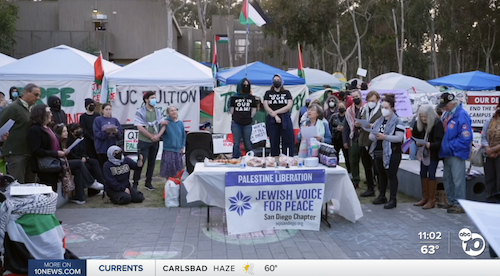
Jewish students from the Encampment, community members and religious leaders held a Shabbat celebration on May 3 in front of the Encampment. ABC 10 News cited one participant who said "I think it says there is a fundamental human rights issue at stake here" and reported, "Jewish community members told ABC 10 News they felt a greater responsibility to show up Friday, to publicly stand against what Israel is doing.
'Showing support as someone who has the oppressor's blood, saying hey, this is wrong,' said Dave Engel. 'We want to take back our culture, and so we will do it here to show solidarity with Gaza,' said Avraham." 86
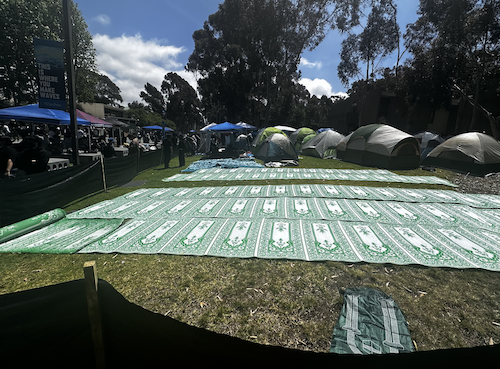
Likewise, Muslim students and participants at the UCSD Gaza Solidarity encampment held congregational and daily prayers— such as Dhuhr, Asr, and evening prayers —on a regular, daily basis as part of the Encampment's routine schedule. Prayers and spiritual gatherings were integrated directly into the daily programming alongside teach-ins and rallies. Prayer spaces were protected in solidarity with vulnerable students. When Muslim students held their daily congregational prayers, non-Muslim peers—including Jewish and secular students—formed protective human chains around them to ensure privacy and security from counter- protestors and exploitative media.
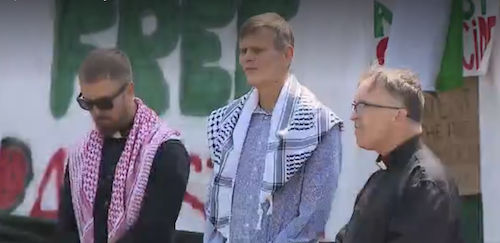
On the third day of the protest, regional faith leaders held a joint press conference and rally. As reported by Fox 5 News, “At this moment I am here to stand in solidarity with our students in this encampment,” said Imam Taha Hassane, Director of the Islamic Center of San Diego. “We are expecting the UCSD administration to respond to them to meet with them and to choose the right route and the right option.” 87
The Encampment featured shared educational and cultural programming. The interior of the Encampment was structured to promote collaborative community building and political education. Through teach-ins and library spaces, faculty and graduate students conducted alternative lectures and lectures open to the public, transforming the camp into a living classroom. Community tables also held literature, educational pamphlets, and zines. Cultural expression was facilitated by the integration of art, collective mourning, and celebrations, such as communal Palestinian Dabke dancing, poetry readings, and shared Shabbat services.
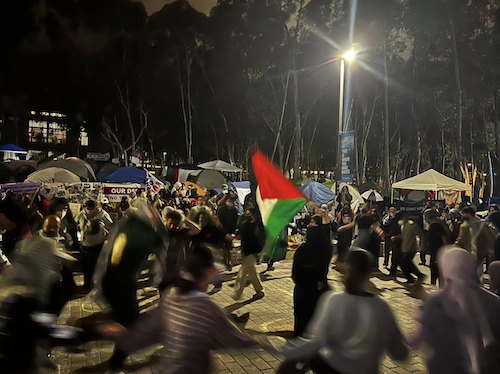
7) Disciplined Organizing Space Under Surveillance and Pressure
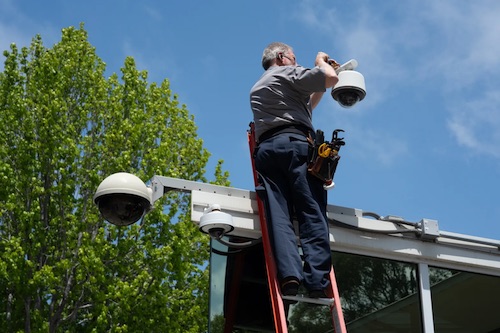
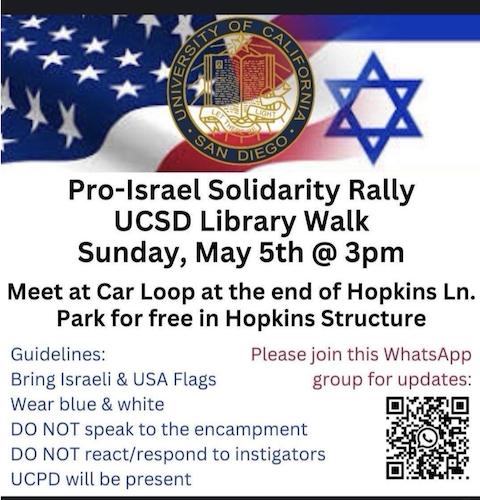
The Encampment was surveilled extensively, both with video cameras 89 and by administrative staff taking notes, and by counter-protesters video-recording and audio-recording at its periphery. The senior administration incited hostility toward the Encampment by describing the Encampment as being dangerous, in violation of rules, disruptive to campus operations, implicitly violent and uncivil (activating anti-Palestinian and anti-Arab racist tropes, and anti-Muslim bigoted tropes – see the section Notes on the Senior Administration’s ‘Fact Sheet’). The Encampment was periodically disrupted by small groups of counter-protesters seeking to provoke Encampment members or initiate confrontations. A large counter-protester rally and march took place on Library Walk in front of the Encampment on May 5. (It is worth considering what the reaction of authorities would have been if pro-Palestinian demonstrators had analogously conducted a rally outside of the Hillel Center at the south end of campus.) Confrontations could be used against the Encampment regardless of the origin of the aggression, given senior administration's consistent biases and political commitments. For example, the UCLA Encampment was cast as violent by the Chair of the UC Board of Regents after it was attacked by vigilante counter-protesters on April 30, 2024.
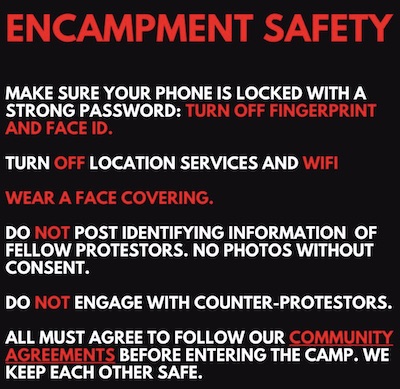
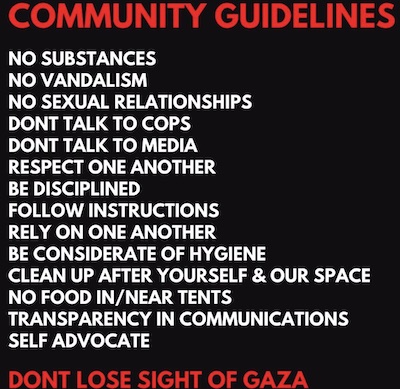
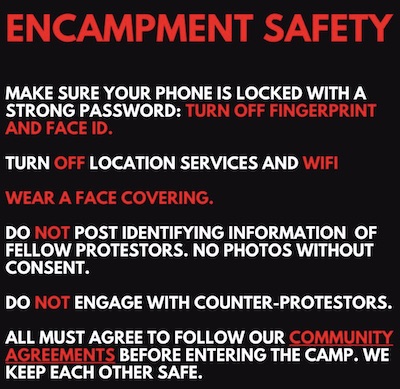
These facts required the Encampment to adopt a disciplined, well-organized and adaptable stance, but at the same time to be open to students, staff, faculty and community members with a very broad range of knowledge and perspectives. That student organizers were able to accomplish organizing a successful, peaceful and safe Encampment with less than two weeks for planning (following the establishment of the first major Encampment at Columbia University on April 17 12) was nothing short of spectacular. But for the Palestine Exception to Free Speech 44, UCSD would have showered the organizers with awards for their skill in learning the lessons of history and in putting into practice methods for community-based education and research that they had learned about in their classes. The organizers relied on a largely horizontal organizing model that had been refined over several decades by liberation movements across the globe. 90 They developed detailed demands, thoughtful community guidelines, and protocols for safety and published those on the first day of the Encampment. (In some organizing contexts these would be termed Points of Unity or Community Agreements). The aforementioned guidelines and protocols required all who wished to join to familiarize themselves with those guidelines and protocols. 91, 92 They developed plans for mutual aid within the Encampment, so that all the needs of those present would be provided for. They distributed responsibility for safety, mutual aid, Encampment maintenance, education, research and community engagement among all of the members, so that everyone was invested in the smooth functioning of the Encampment. Such a feat within the hierarchical structures of UCSD would have taken faculty and administrators years of planning and millions of dollars in funding.
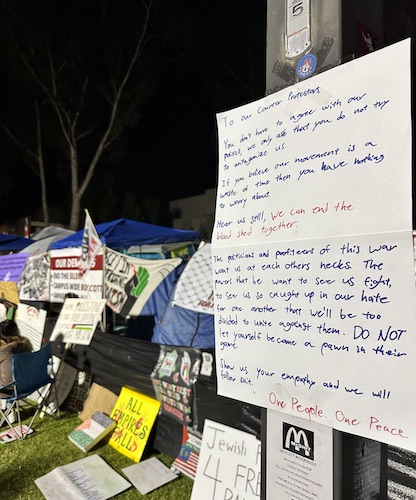
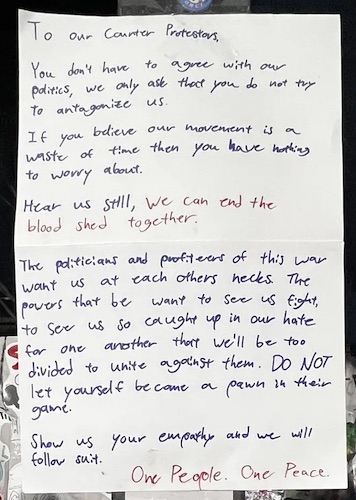
Far from the lies told about the Encampment, signs reflected good will and love for all. Some signs were messages to counter-protestors calling for peace and reconciliation to stop "hate" and "blood shed."
Safety was a theme for students and those faculty who stood by their students' rights to peacefully protest.
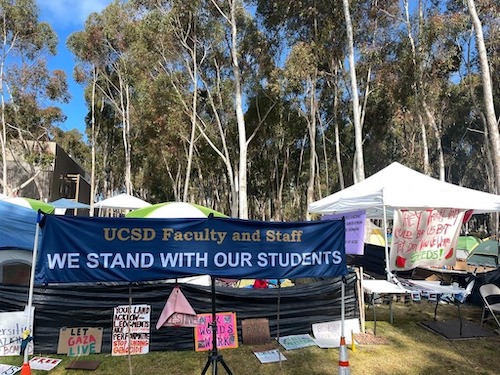
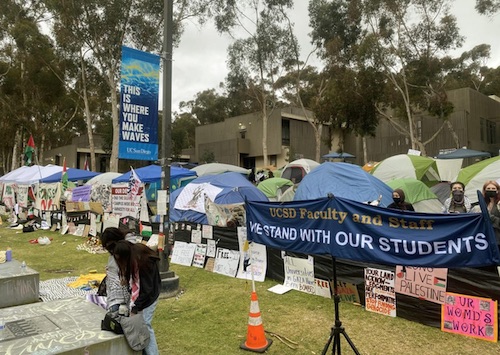
Dozens of faculty and staff gathered outside of the Encampment near the sign "UCSD Faculty and Staff WE STAND WITH OUR STUDENTS" to show their support. Faculty were present 24 hours per day throughout the duration of the Encampment.
Chants were especially helpful to members of the Encampment when counter-protestors marched on Library Walk. Members of the Encampment formed a line shoulder to shoulder with their back to the Encampment, leaving Library Walk clear, and chanted "Free Palestine" to sustain themselves as they endured genocide-supporters heckling them.
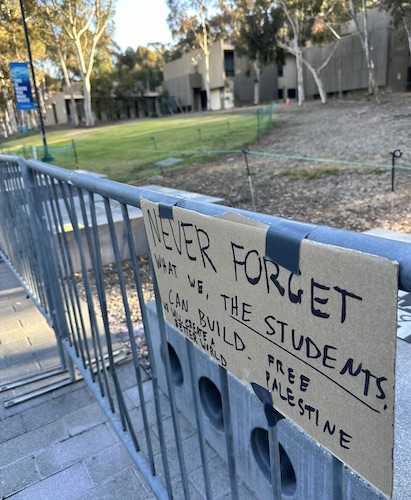
The day after the May 6th violent police raid, arrests and destruction of student property and signs, new student signs appeared showing their understanding of those responsible for complicity in genocide, and named UCSD Chancellor Khosla as the architect of their own vulnerability to danger.
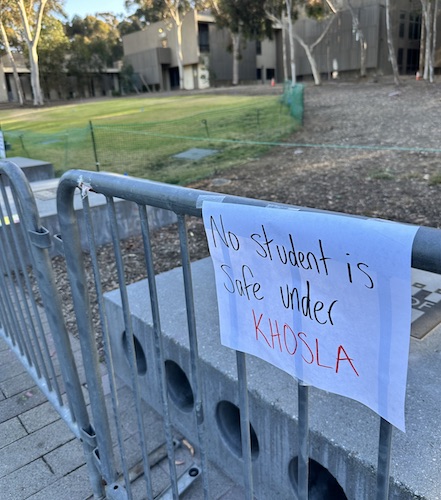
After the police raid on the Encampment, signs reflected the resolve of students in the wake of an attack directed by UCSD senior administration: "Students for Peace, attacked by the police. Your tuition funds this."

Another sign on May 7, 2026 reminds passersby to "Never forget what we, the students can build. We will create a better world. Free Palestine."
Summary Timeline of the UCSD Gaza Solidarity Encampment (See Also This Visual Timeline)
Whereas it would be impossible to offer an exhaustive account of the Encampment, the following timeline recounts key moments of this rich, multidimensional space.
May 1: Encampment
1) "Today, May 1 at 11:40 a.m., a group of UC San Diego students and community members gathered on the green across from Geisel Library to set up an encampment in response to the ongoing genocide of Palestinians in Gaza and the UC’s failure to divest funds from and condemn Israel. The encampment consists of over 20 tents spread out across the green, surrounded by a barrier made up of tarp and wood. Inside, protesters have set up designated food, water, medical, trash, and recycling stations. Hung up on trees and tents around the camp are signs with demands and words of support for the greater movement, including 'Free Palestine,' 'Stop Arming Israel,' and 'UCSD Faculty Supporting Ceasefire.'" 93, 94, 95
2) The organizers of the Encampment issued Encampment Safety and Community Guidelines that all must agree to follow before entering the Encampment. 91, 92
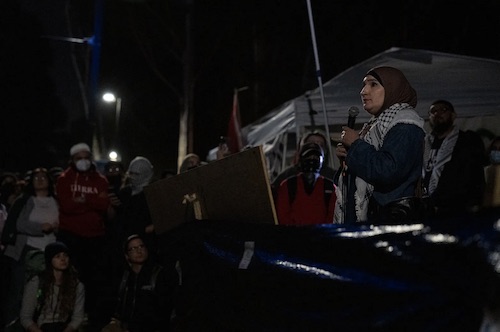
3) Palestinian-American Feminist Linda Sarsour spoke at the Encampment in the evening, stating “I remind your administrators that you stand in a long tradition of student activism that ended the Vietnam War. That ended South African apartheid. And that universities who divested from South Africa can also divest from the State of Israel... I promise you 20 years from now you’re gonna be right. And your school will probably put you on a page on their website and talk about the incredible student activism of 2024." 95
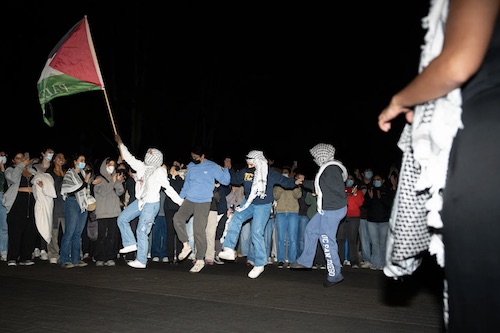
4) Students celebrate Palestinian culture with traditional Dabka dance. 95
5) In response to calls for boycott and divestment, a UCSD spokesperson referred to this statement: 'The University of California “has consistently opposed calls for boycott against and divestment from Israel,” a statement from the university’s Office of the President said. “While the University affirms the right of our community members to express diverse viewpoints, a boycott of this sort impinges on the academic freedom of our students and faculty and the unfettered exchange of ideas on our campuses.”' 96 This disingenuous statement misconstrues the specifics of the call for an academic boycott, which focuses on cutting institutional ties, not academic-academic contacts and collaborations. (Specifically: "The BDS National Committee, including Palestinian Campaign for the Academic and Cultural Boycott of Israel, is committed to freedom of expression as stipulated in the United Nations International Covenant on Civil and Political Rights (ICCPR) and, as such, rejects, on principle, boycotts of individuals based on their opinion or identity (such as citizenship, race, gender, or religion)." 97
6) AVC of student life Patricia Mahaffey "communicated to a few members of Associated Students that the UC Police Department will be conducting student ID checks at the encampment tonight" causing stress and panic among students. No ID checks were conducted. 98
7) Locks of offices of Student Initiated Access Programs and Services (SPACES) were changed without notice in response to the Encampment, leaving Student Affirmative Action Committee orgs without a safe community space or access to their personal belongings. 98
8) Speaking to the Encampment, Professor Gary Fields said "We are learning from you about making the world a better place, we are the students and you are the teachers... You the students out here are showing us the meaning of free speech and academic freedom, you are showing us the meaning of what a university is supposed to be." 99
May 1: Gaza
1) Students in Gaza thank students establishing Gaza Solidarity Encampments 100
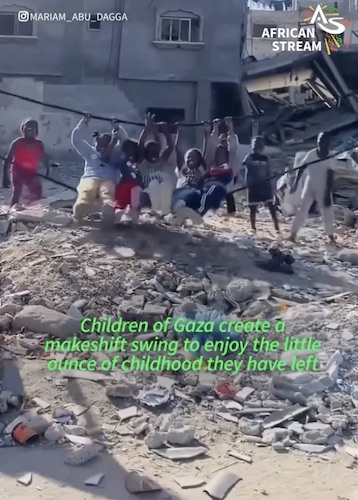
2) Children in Gaza create a makeshift swing from collapsed power lines and continue to play in defiance of the unfolding genocide 101
3) Israeli soldiers shoot at, strip and torture young men trying to escape Gaza City 102
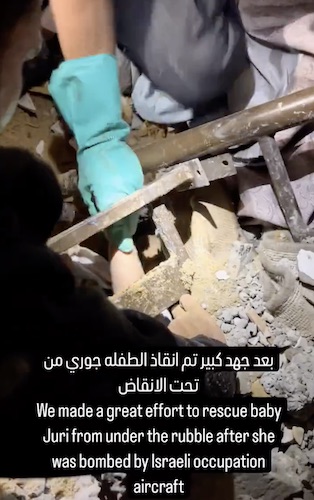
4) Rescuers dig baby Juri out of the rubble of a house destroyed by Israeli warplanes 103
May 2: Encampment
1) 'A Palestinian father outside of the tent encampment barrier got emotional as he talked about how more than a dozen of his family members have been killed in Gaza. "Why are we killing those people? Why are we enabling the criminals, the genociders, with our own tax money, our tax money," said the father. He was born in Rafah, in the southern Gaza strip, and says he is proud of his Jewish friends and faculty standing in solidarity with Palestine. "It's the most injustice that you can ever imagine," he added.' 104, 105
2) A UCSD senior with extended family in the West Bank said "The amount of cultures, identities, and religions that we have in this encampment, in this community that we have created is bringing us together. It’s not just centered on Gazan people, but it’s centered on all marginalized and oppressed people across the world." 106
3) From Students for Justice in Palestine and Jewish Voice for Peace at UC San Diego statement on the cancellation of the Sun God Festival: "Students for Justice in Palestine and Jewish Voice for Peace at UC San Diego unequivocally reject the premise of the statement released by the campus administration announcing the cancellation of Sun God festival. The administration clearly names our peaceful demonstration against Israel's genocide as the ultimate reason for canceling Sun God. While the administration states they did this in the guise of 'security limitations,' we know very well that the school has the funds to facilitate security for the festival... SJP and JVP remain firm in our stance that there can be no business as usual in the midst of a genocide. The administration's decision was clearly not made with the student body's best interest in mind, rather, it was made with the intention of creating division among fellow students in the hopes of shutting down our demonstration. We will not let this cheap attempt to sow division among each other distract from the nationwide call to action in support of Palestinian liberation and an end to this genocide." 107
May 2: Gaza
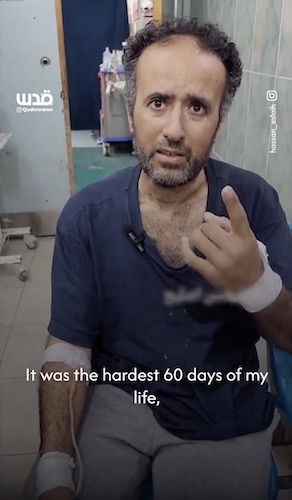
1) Palestinian abducted by Israeli Occupation Forces (IOF) in Gaza testifies to beatings, torture and humiliation in detention camps 108
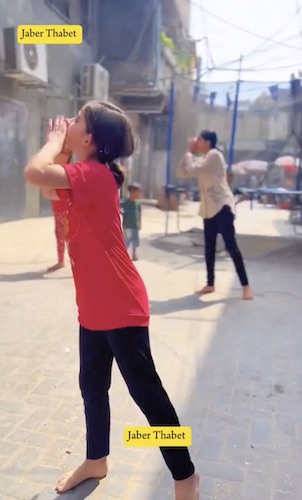
2) Dabke by children in Nuseirat Refugee Camp 109
May 3: Encampment
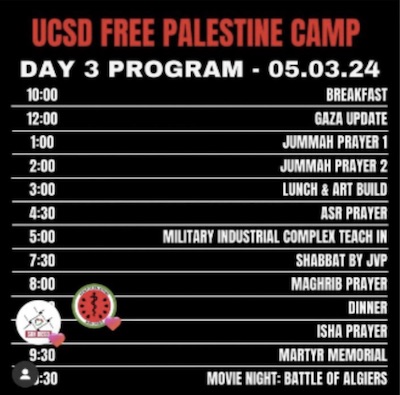
1) The names of all infants (one year or less in age) murdered by Israel up to that point in time were read in a ceremony in front of an electric candlelit memorial poster that listed their names. 110
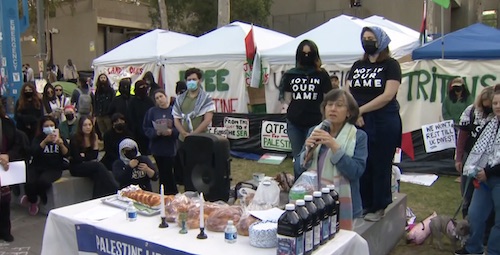
2) Jewish Faculty and Students at UCSD released a statement in support of the Encampment: "Jewish faculty, students and staff at University of California San Diego, together with Jewish community groups, stand in full solidarity with student protestors who have erected the 'Gaza Solidarity Encampment' on Library Walk on the La Jolla campus. Tonight Jewish students and faculty, organized by Jewish Voice for Peace at UCSD and Jewish Voice for Peace San Diego and led by Rabbi Alexis Pearce, will join to light candles and say the Shabbat blessing together with students and community members from diverse faiths and backgrounds... We agree with Professor Rashid Khalidi of Columbia University when he said 'This is the conscience of a nation, speaking through your kids' and we recognize the courage and commitment of the students who are camping out. We reject the dismissal of these peaceful encampments as anti-Semitic, or that they create a hostile environment for Jewish students and faculty. We recognize anti-Semitism as a real form of discrimination that harms our communities but reject the premise that criticism of the state of Israel and its actions is inherently anti-Semitic." 111
3) Avraham said at the Shabbat celebration "I'm tired of the dehumanization of the Palestinian people, not recognizing their existence, their heritage, their roots..We want to take back our culture, and so we will do it here to show solidarity with Palestine." 112
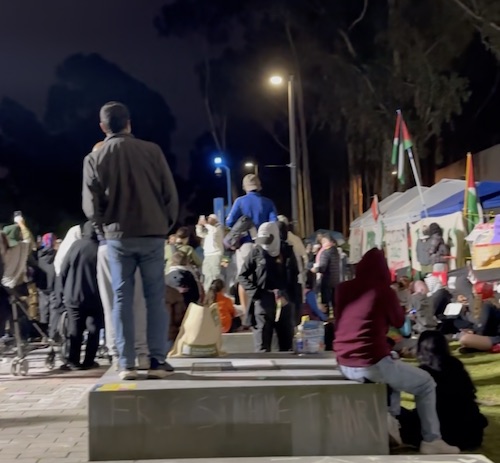
4) At about 8:15 PM on May 3, rapper Macklemore provided an early release of "Hinds Hall" to Encampment students, a track expressing support for Encampments across the country. The title of the track originates with the renaming of Hamilton Hall by Columbia University's Gaza Solidarity Encampment as Hinds Hall, referencing Hind Rajab, a five-year-old Palestinian girl murdered by Israeli soldiers in Gaza City. 113 “What're you willing to risk? What're you willing to give? What if you were in Gaza? What if those were your kids? If the west was pretending you didn't exist, you'd want the world to stand up. And the students finally did!” 114 Macklemore, as well as scholars Noura Erakat and Robin D.G. Kelley, honored the students of UCSD's Gaza Solidarity Encampment with personal messages at their People's Graduation, held for students in Gaza not able to graduate that year, at Balboa Park on June 14, 2024. 115
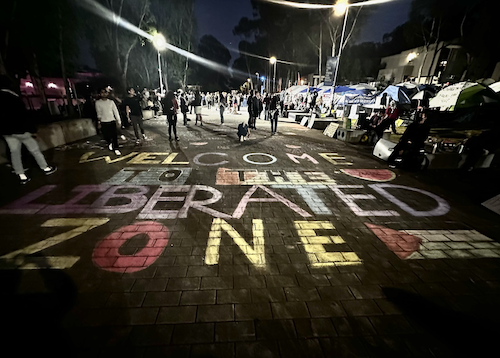
5) Students and community members including children visiting the encampment extending messages of love and hope for the Palestinian people and the end of the genocide in Gaza with beautiful chalking along Library Walk. By evening, the messages were stunning in their beauty and dreams of liberation for all.
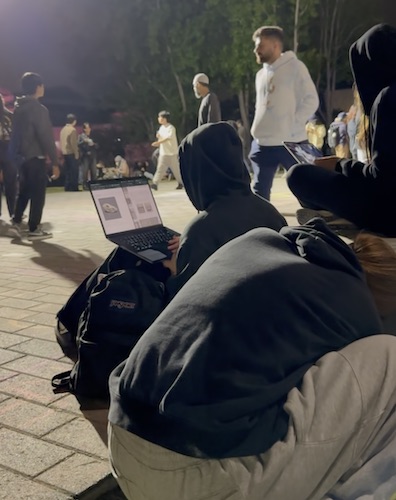
6) Students were observed studying for their classes late into the night. At this point, the administration had closed the library, making it increasingly difficult for students to express their opposition to UCSD's complicity in the genocide and maintain access to the resources their tuition guaranteed. Despite this, students persevered, reading and completing their work late into the night on concrete blocks adjacent to the Encampment.
May 3: Gaza
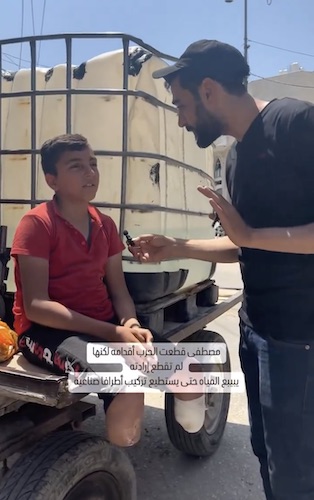
1) Twelve year old Mustafa sells water in hopes of buying prosthetic legs to replace those lost in bombing of their home by the IOF 116
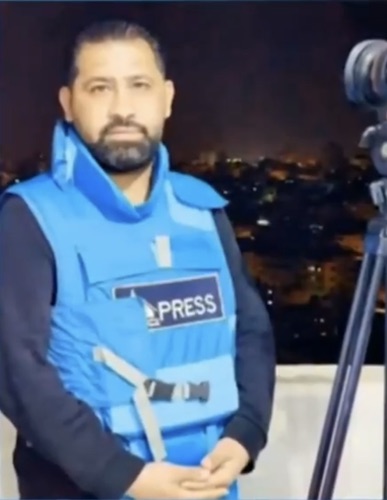
2) Remembering Saeed al-Taweel, a Palestinian journalist murdered in Gaza City as Palestinian journalists were awarded UNESCO’s world press freedom prize 117
3) IOF using a civilian in Gaza as a human shield. 118
May 4: Encampment
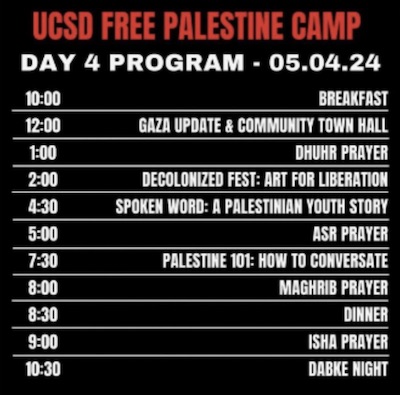
1) An Encampment media liaison described interactions with UCSD administration: "They haven't responded at all. We're hoping that they can come out and try to talk to the students, but for the past four days, we have heard nothing. It's really disappointing to see that they are out here trying to bring in people to try to close down the Encampment but they're not out here trying to listen to their students." And, regarding the gradually increasing size of the Encampment: "We have a lot of students passing by on Library Walk and they're seeing the Encampment, they're talking to the students inside the Encampment, they are getting educated on what's happening and the demands of the students and deciding this is something they want to participate in." 119, 120
2) Encampment organizers released a statement regarding safety at the Encampment and increase in Encampment size: "Since day 1, students have been threatened with arrest, suspension and physical intimidation. Our Encampment has maintained a higher degree of discipline and professionalism than we have been shown by the administration. The size of the Liberated Zone of the Encampment was too small to facilitate the safe and peaceful exercising of our rights. Arab and Muslim students who are outside of the Encampment have encountered harassment, threats, and privacy invasion, and an expansion of our Encampment became necessary to protect the student community. Because the UC system has so grievously injured its students in LA and provided no framework or dialogue for ensuring our safety, it is our responsibility to establish basic safety measures on the ground. Horrific videos of UCPD and 'counterprotestors' attacking and maiming students have demonstrated the unwillingness of the UC system to meet its basic responsibility towards its students.... A small expansion of our footprint into open, unused areas could not be called an escalation in any sense of the word. Student demonstrations have long been an important and expected part of higher education. We encourage UC administration to reevaluate its aggressive posture. We reaffirm that the highest responsibility of a university is to its students above all else." 121
3) From a statement by Associated Students of UC San Diego officers and senators: "On May 1st, UC San Diego joined our fellow campuses across the nation peacefully standing against the genocide in Palestine during a crucial moment in history. We would like to reaffirm our commitment to supporting students lawfully exercising their fundamental rights to engage in free speech and peaceful assembly. We stand in solidarity and fully support all of the demands presented... We demand Chancellor Khosla, Vice Chancellor of Student Affairs Alysson Sutterlund, Vice Chancellor of Equity, Diversity and Inclusion Becky Pettit, Interim Vice Chancellor for Resource Management and Planning Maureen Harrigan, UC Police Department, and all other administrative units directing campus actions not to resort to violence. We demand the the administration keep peaceful demonstrators safe from violent agitators. We demand that the administration meets in good faith the demands of the Gaza Solidarity Liberation Zone. We demand that all students and student-employees in the peaceful liberation zones do not receive conduct violations, suspensions or other punitive actions for participating in a peaceful demonstration... We demand that the university stop all retaliation against student employees, many of whom rely on their jobs to live." 122
4) Poetry reading in the afternoon. "The first student performer recited “If I Must Die” by Dr. Refaat Alareer, followed by her original poem “To Be Palestinian.” A second student performer performed an original poem and recited “On This Earth What Makes Life Worth Living” by Mahmoud Darwish. A third speaker recited “I Am You” by Dr. Refaat Alareer and then read an original poem. Finally, a fourth speaker recited “This is Why We Dance” by Mohammed El-Kurd." 4
5) Faculty supporters of the Encampment remained outside the Encampment 24 hours/day in shifts to discourage and de-escalate potential violence ordered by UCSD senior administration, as had happened at UCLA earlier in the week. 123, 124
May 4: Gaza
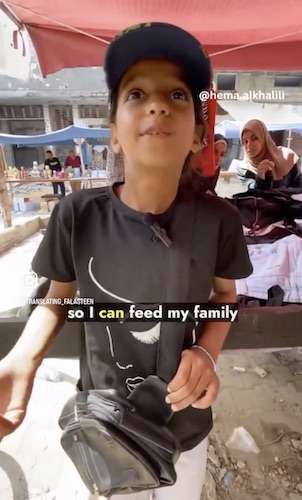
1) Farah Miqdad, whose brothers were martyred in the genocide, sells clothes to support her family in Gaza City. 125
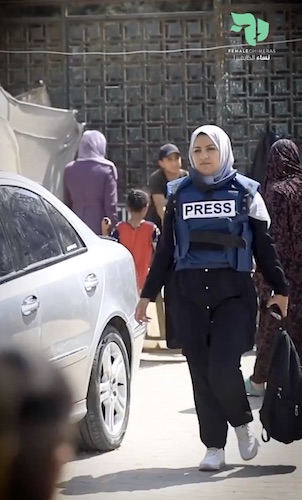
2) Haneen Hamdouna, a Gaza journalist, fears identifying as press because the IOF targets journalists 126
3) IOF torture a Palestinian prisoner abducted from Nasser Hospital in Khan Yunis 127
May 5: Encampment
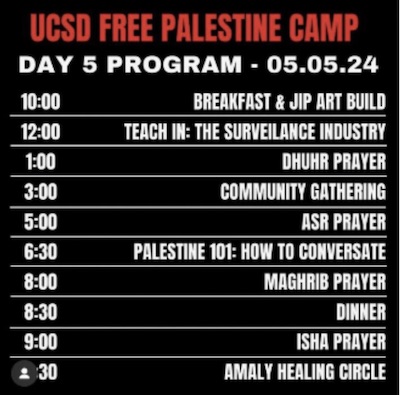
1) According to reports by protesters and faculty, UCSD Chancellor Pradeep Khosla refused to follow up on an attempt by then Academic Senate Chair John Hildebrand to arrange a meeting between the Chancellor and organizers of the Encampment.
2) Professor Lilly Irani led a teach-in on the topic of surveillance, addressing questions such as a) Who is spying on us (the usual suspects)? b) How do they spy on us (id cards, video streams, social media, phones, computing)? c) What are the boundaries and identities policed by surveillance (racialization, etc.)? d) In what ways has surveillance been resisted (hackers, defunding, targeted campaigns, community)? 128, 129
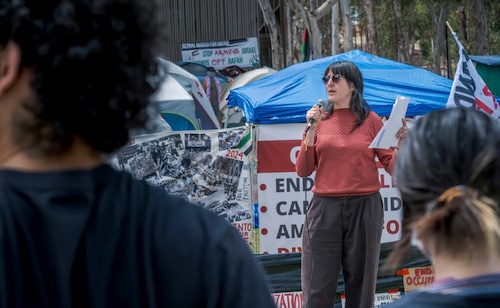
3) Hundreds of pro-genocide counter-protesters rallied and marched in front of the Encampment, blocking Library Walk, yelling profanities and menacing bystanders with 'You're going to lose your job,' but despite the provocation, members of the Encampment refused to engage and no clashes occurred. 129
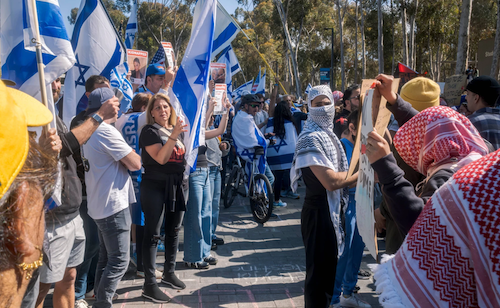
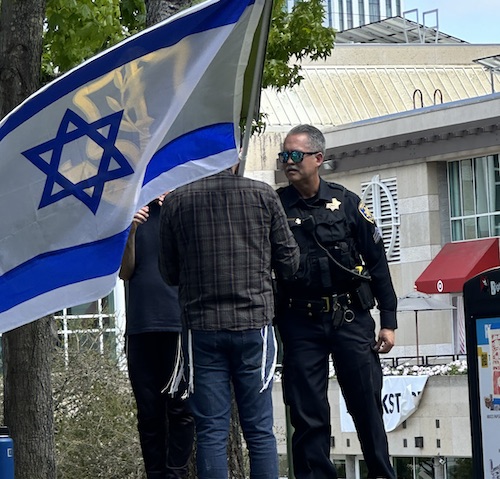

Members of the Encampment reached out to counter-protesters with a message of love, hope and reconciliation.
5) Encampment organizers responded to increasing threats of sanction and violence by UCSD senior administration "We reject the false narrative painted by Chancellor Khosla of the Encampment being disruptive or potentially unsafe. Camp leadership has successfully cultivated an atmosphere of respect, unity, and mutual understanding without resorting to threats of academic or legal punishment or physical intimidation, which is all the university administration has offered. It is notable that Chancellor Khosla acknowledges the threat of violence from outside the Encampment, yet all of the administration's threats and denouncements have been directed at us rather than the outside instigators. ... All administrative and police action has demonstrated that their priority is to protect white supremacist and violent non-students over UCSD's own Arab and Muslim student community. ...The organized student leadership is ready at any time discuss our demands. The camp could be dispersed tomorrow if UCSD would fully divest from the genocidal apartheid regime." 130
May 5: Gaza
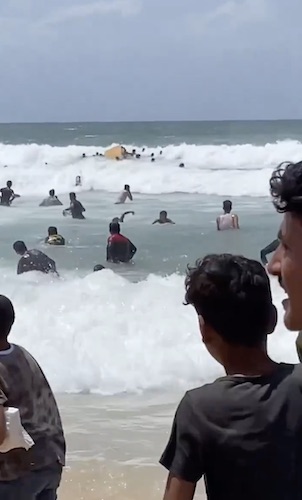
1) Palestinians drown attempting to retrieve food aid from ocean off Gaza Beach. 131
2) IOF bombs drop adjacent to tent encampments in Rafah 132
3) Gazan journalist Salem Abu Toyour and his child Ahmad killed in an IOF airstrike 133

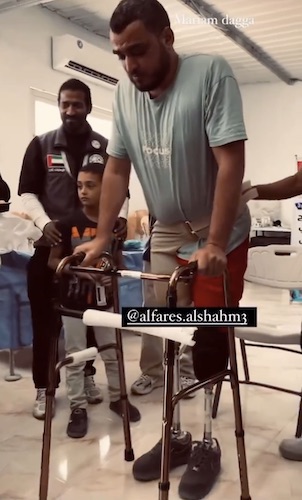
4) Genocide relief effort engineer Ahmed receives prosthetic limbs to replace legs lost in IOF bombing of his home 134
May 6: Encampment
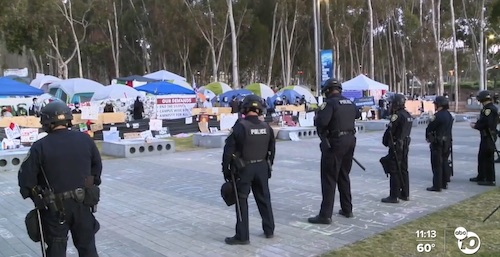
1) The night of May 5-6 was quite cold, but with little wind. The previous night had been wet, drizzly, cold and windy. The morning of May 6 was beautiful, clear and calm. In the early mornings on Library Walk, some fan noise is audible in the background, but otherwise it is very quiet and calm. Before the sky began to lighten, a chorus of birds starting singing, one species at a time. The pink tones of the brightening sky brought the volume up on the bird chorus. One of the camp security folx yelled out. A line of maybe 50 police in riot gear were observed marching like Nazi stormtroopers towards the Encampment. 135
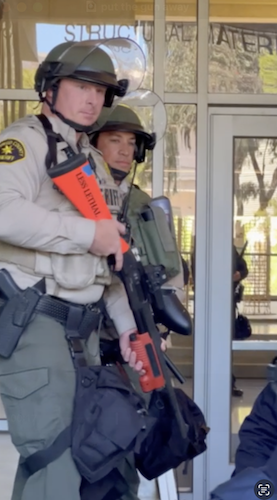
2) Approximately 200 police wearing riot gear from UCPD, San Diego Sheriffs and California Highway Patrol descended upon the Encampment. Members of the Encampment stood behind sheets of plywood to defend themselves against the expected onslaught of baton blows and rubber bullets. 136
3) Chancellor Khosla shuts down the campus and orders instruction to be moved online 137

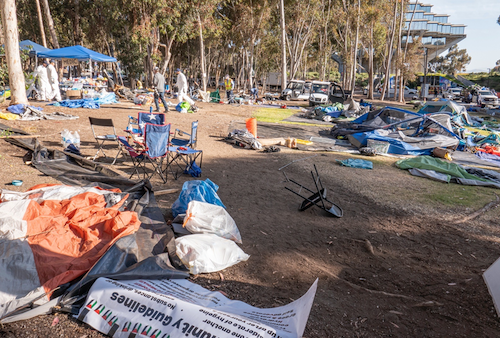
4) Police violently dismantled the Encampment, arresting 64 students, faculty and community members. Police were heard laughing and joking as they destroyed Encampment displays and structures.
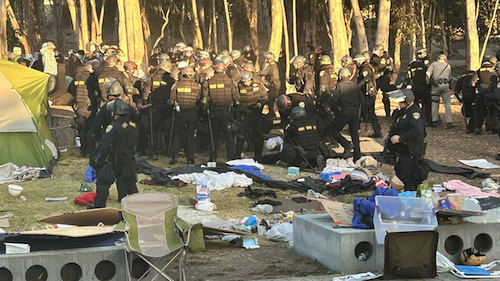
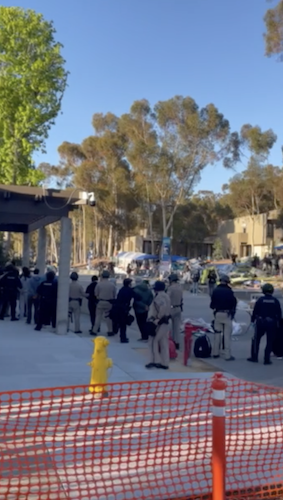

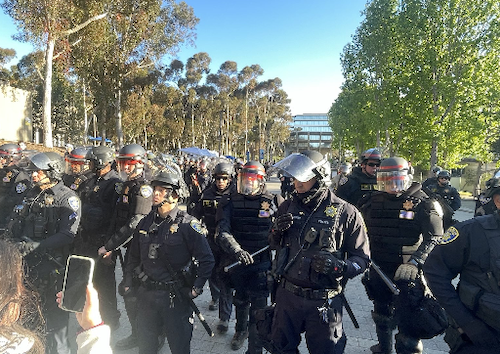
5) The UCSD Gaza Solidarity Encampment, lovingly constructed by Palestinian, Arab, BIPOC, Trans, Queer, Muslim, Jewish and Christian students seeking justice for Palestine, is treated by a racist, anti-Muslim bigoted senior administration as trash to be cleaned up.
6) Thousands of protesters come to campus to protest the violent dismantlement of the Encampment and demand that those arrested be released. Students and faculty chanted outside of Price Center, where police held handcuffed members of the Encampment.
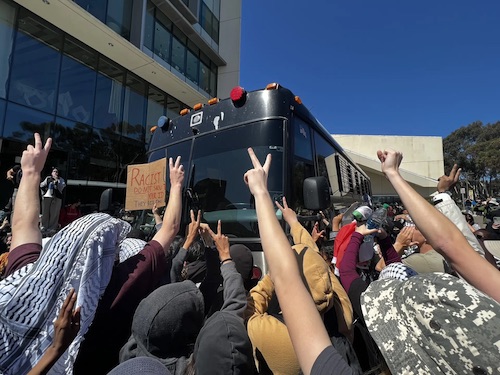
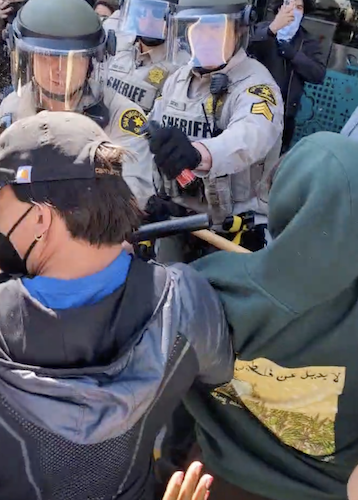
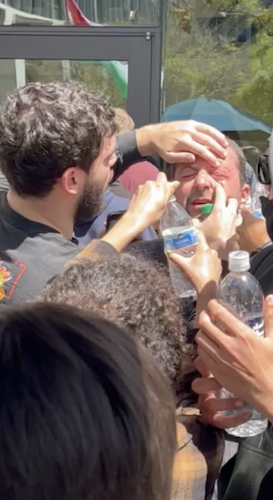
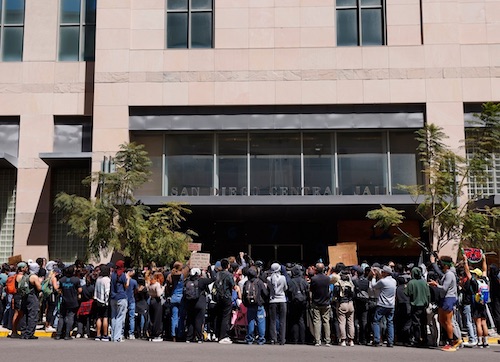
8) Support crews gather outside the downtown San Diego Central Jail and Las Colinas Detention Facility to greet, care for and transport those arrested for protesting the genocide in Palestine upon their release. 138
May 6: Gaza
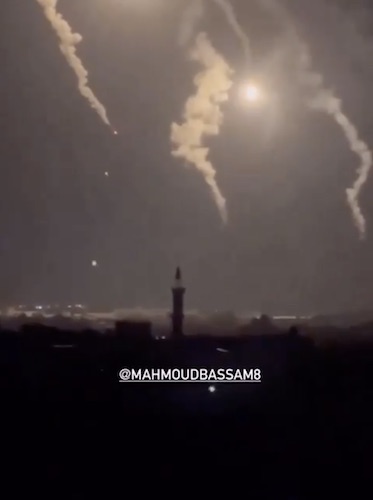
1) Ground invasion of Rafah begins 139
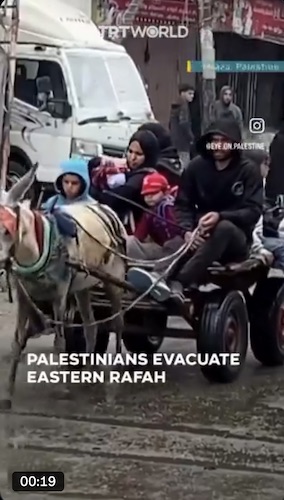
2) Families fleeing Rafah in advance of IOF ground assault 140
3) IOF attacks an aid warehouse at the Rafah crossing amidst a famine 141
4) Carrying a wounded child to Al Kuwait Hospital following a home bombing by IOF 142
5) Twenty-one bodies out of many more recovered from rubble of 11 Rafah homes bombed by the IOF 143
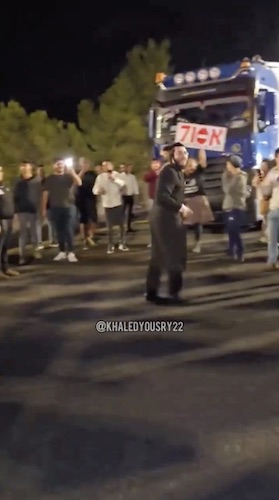
6) Israelis destroy aid trucks meant for Gaza in the West Bank and celebrate 144, 145
7) IOF uses cancer ward of Turkish Hospital in Deir al Balah as a military base 146
8) Doctors treat a child at the Kuwait Specialty Hospital following IOF bombing 147
Aftermath: Encampment
In the wake of the violent dismantlement of the UCSD Gaza Solidarity Encampment, faculty, students and community members denounced the senior administration's anti-Muslim, anti- Arab, anti-Palestinian racist and bigoted actions and they called for change.
“I think for a lot of students, it was their first time experimenting with what critical people power was like. And so for a lot of folks, I think there was excitement; there was energy that was really healthy in many ways.” – Husayn || “When they put me in cuffs, what immediately came to mind was the mass graves that they found in Gaza, people who were found wearing the exact same cuffs that were found dead and buried there. So I wasn’t scared of anything that police or school could do to me because it’s nothing in comparison to what other people are currently experiencing — what the martyrs in Palestine experienced before they died.” – Millian || “I definitely think there were a bit more biased actions that they used towards certain people. ... They were slightly more humane towards some people that were more white- appearing, as opposed to those that were not. Whether that’s once they saw your name or the actual color of your skin.” – Redacted || "There were a couple that were huddling together in groups, pointing at students, making jokes and laughing at us... My reaction wasn't fear, it was more so anger. I was pissed that these people, these fully grown men with guns, batons, shields, all their weapons, thought it was so humorous what they were doing to us."" –- Millian || “Can nobody see what’s going on? Is nobody gonna stand up for us? I thought of the kids in Gaza. So this is what it’s like to live in a camp, except we have a ton of resources and community support. So imagine what it’s like living in a camp without those things. And then you’re standing in front of the police, and you’re like, now imagine your mom is 10 feet under the rubble.” – Sunflower || When the sliding doors opened and we heard the crowd, it made me feel like I wasn't alone. In my experience being arrested, in my struggle against police, and in my struggle for a free Palestine, just that indescribable feeling of solidarity. It was that feeling of solidarity in is purest form, when people came out in solidarity with us and the cause." – Willy || "I feel like both my identities, being queer and being Jewish, are being weaponized right now to justify what is going on in Palestine. And i want to make it very clear that Judaism is inextricably linked with freedom from oppression. It's not in spite of my Judaism that i believe in a free Palestine, but rather because of it." – Skylar
Voices from Inside the Encampment/UCSD Guardian 148
“Today’s events directly contradict what we teach, including the rich history of activism at UCSD, which has long been celebrated as a beacon of social change and progress. The actions taken by the administration stand in stark contrast to these values, undermining the very ethos of our institution and betraying the legacy of those who have fought tirelessly to make UCSD a place where activism is not only welcomed but celebrated... We demand accountability from the UCSD administration. We call upon them to acknowledge the harm caused by their actions, to immediately cease all further use of force against peaceful protesters, and to engage in genuine dialogue and reconciliation with the affected members of our community.”
UC San Diego Graduate Students 149
“The encampment was a beautiful community space; for some of us the most beautiful community, cultural and educational space we have ever seen in several decades at UC San Diego.”
246 UC San Diego Faculty Members 150
“We condemn the retaliatory actions already taken by UC San Diego Administration against student protesters, including arrests, suspension and threats of suspension. This followed a week of intimidating behavior, including threats and lockouts of student spaces by administration, as documented by students and media. These threats and lockdowns make our community less, not more, safe, especially for students with lived experiences of traumatic and punitive systems. We are especially troubled by administration’s repeated turn to "safety," including language in Chancellor Khosla's May 5th email, to justify retaliation against students. His claim that encampment activities are "dangerous" and pose a safety concern stand in contrast to mainstream media descriptions of the campus protest.”
San Diego Faculty Association 151
“While the Chancellor wrongly claims that the encampment threatened safety, it was the administration's response that posed the real threat. Hostile actions by the administration and the police they ordered onto campus caused disastrous upheaval, including physical injuries and an authoritarian fracturing of peaceful student organizing and community. The deployment of police, including snipers on top of the Student Health Building, was a shocking abdication of the Chancellor's mandate to support and protect our students... We demand the immediate resignation of Chancellor Khosla. His actions this morning placed hundreds of students in danger at the hands of aggressive, militantly organized police and resulted in arrests and injuries; violated the constitutional rights of our students to peacefully assemble and protest; and demonstrated a level of hostility against our students that has absolutely no place among University leadership... We demand police be removed from campus immediately and permanently. UCPD, San Diego County Sheriffs, California Highway Patrol, and all other police have no place on the UC San Diego campus and should never be called upon to surveil, repress, and threaten our students.”
UC San Diego Ethnic Studies Department Faculty 152
“Faculty have been in regular contact with students at the encampment since it was first established, participating to varying degrees in their educational activities. Despite the multiple channels of open and available communication, upper administration nonetheless unilaterally chose a set of actions – summoning multiple heavily-armed law enforcement agencies, the last and most extreme option – rather than an approach that would have been defined by de-escalation, dialogue, and mutual respect... Although the campus was essentially closed down to students, staff, and faculty on the morning of May 6 with very little notice, the media were present to document the police response, situating themselves primarily behind a line of officers clad in riot gear. News cameras appeared to have been given unfettered access to the scene, often moving freely among mobilized police officers while protesters were cordoned off into separate areas. In addition, after protesters were cleared from the encampment, local media were permitted to roam through the area, broadcasting their own perusal of personal belongings and other materials... Police appeared to selectively remove items of clothing from the students; most notably, in several instances visible on local media’s news streams, police were seen deliberately and roughly removing keffiyehs from around protesters’ necks, which they then dropped to the ground and trampled.”
UC San Diego Department of Communication Faculty 153
“We condemn writing that does violence by concealing the depths. Writing, like that of the Khosla administration, that criminalizes peaceful protestors and demonizes them in the official record. Writing that claims to prioritize the safety of the campus but behind the scenes invites a small army of militarized riot police to confront our students. The slick corporate writing of weapons manufacturers and climate killers that lures students to their world-killing work. Writing, written in shadows, that hides the destructive corporations where student tuition and university endowments are invested. Writing that erases history while weaponizing historical trauma. Writing that turns Palestinians into non-people whose lives and deaths are marginal notes in history. Writing that hides away the Palestinian dead under a rubble of uncontroversial words and obscure bylines. Words as billy clubs, as bullets, as bombs.”
Members of the UC San Diego Writing Community 154
"We are deeply disappointed in the professors, faculty, administrators, coaches and other UC San Diego personnel who thus far have failed to condemn the cruelty student protestors were met with on May 6th and have failed to call for the removal of Chancellor Pradeep Khosla; their silence in the wake of the risks posed to the student body is heartbreaking and speaks volumes of their commitment to the students they serve. We firmly support the people of Palestine who face a calculated genocide executed by the Israeli Occupation Forces... We denounce America’s billions of tax dollars that fund this ongoing genocide through weapons packages labeled as “aid.” We denounce UC San Diego’s investment in weapons manufacturers such as Lockheed Martin and Raytheon. There must be a UC where our tuition, learning, and research ensures collective, international liberation. "
UC San Diego Food Cooperative, General Store Cooperative, KSDT Radio, Che Cafe Collective, and Groundworks Books Collective 155
"The events of May 6 were disquieting and disillusioning. It seems to prove that the University is willing to do anything to suppress certain kinds of ideas, even resorting to violence. UCSD is still living in the world that May 6 made — where censorship, surveillance, and fear predominate, where one can no longer be certain of the right to speak one’s mind."
Alex Reinsch-Goldstein 156
In a cynical and cruel mockery of the Encampment's goals, senior administration planted grass and erected hammocks on the site of the Encampment in an attempt to erase what the Encampment had revealed: UCSD senior administration actively is complicit in the genocide in Gaza. Ironically, while one of the senior administration's excuses for attacking the Encampment was the university rule that prohibits sleeping on campus, students can now often be observed sleeping in the hammocks. The twisted humor behind the installation of the hammocks exposes the senior administration's disregard for Palestinian lives and for Palestinian, Arab and Muslim students at UCSD.
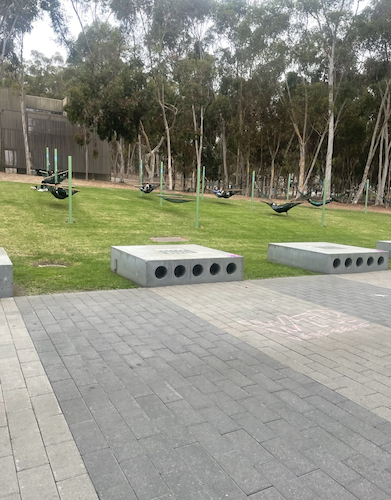
Aftermath: Gaza
In the wake of the savage ground assault by the IOF on Rafah, which began on May 6, numerous individuals, groups and organizations condemned Israel's genocidal actions and a much broader array of international actors recognized that the IOF attacks on Gaza constitute genocide, including human rights NGOs Amnesty International and Human Rights Watch.
“Good morning from Gaza. Good morning from Shuhada Al-Aqsa Hospital... People are treated as a herd of sheep that is being herded by a shepherd who has no mercy whatsoever and who is dictating whatever he wants or she wants, because they have the ultimate power to do things, and they have the ultimate power to destroy anything they want, with the most sophisticated technology they have been using. They have been very happy and proud about the artificial intelligence they have been using for the sake of just identifying who’s combatant, who’s noncombatant. Unfortunately, the statistics from the ground explains how shocking the way people are being targeted. Mothers are killed with their sons. Fathers are killed with their daughters and sons, whole families wiped out, and even now in Rafah area, in the east, west, south now and north in Rafah. In the Gaza south area, in the Gaza north area, in the Gaza central area, nonstop bombardment. And people who were asked to leave Rafah are now in Gaza central area or in Khan Younis, and they are still seeing with their own eyes — I mean, again, the lucky ones who are surviving the bombardments are seeing with their own eyes that there is no safe haven in Gaza Strip. Death is the one major risk enveloping the lives of the people of Gaza. However, starvation is one more equally important threat that the — and challenge that the Palestinians are seeing. Those people who have been living this displacement, destruction and fear for the last seven months are now struggling to secure water for their children — to start with the water, because water is the gift of life, and water is not available in Gaza. Water desalination plants were destroyed... So, no infrastructure, no food supplies, no water supplies, no medical consumables or medications allowed into the Gaza Strip... And the ones who are injured are unable to go to the hospitals, because hospitals are already out of services. The Kuwaiti Hospital was communicated with by the Israeli occupation forces. They asked them to leave the area. The area itself is part of the area that was asked to leave by the Israeli occupation forces. The situation continues to be very dire. People even with normal health diseases are not able to access the hospital, are not able to find proper medication for their wounds or for their diseases or for whatever things they need. And they end up facing that type of slow death, a slow death which means they don’t have access to food, they don’t have access to water, they don’t have access to supplies of any kind, and they are still suffering. And that speaks for the people in Gaza south, in Gaza north, in Gaza central area... No human being whatsoever is allowed to cross Rafah crossing or Kerem Shalom crossing. In the second day of that seizure of the border, a truck was summoned by the Israeli occupation forces for a transporter that is known and identified and recognized by the Israeli army. They went there. Ten people went there. Six of them were shot by the Israeli army. And the truck that was suppose to enter Gaza did not enter Gaza. So, it’s a full and complete closure of the border. No foreigners, no Gazans, no one is allowed to move from that area. And no supplies whatsoever have been entering that area ever since this whole process started in Rafah and Kerem Shalom area.”
Akram Al-Satarri 157
“The Palestinian Centre for Human Rights (PCHR), Al Mezan, and Al-Haq, vehemently denounce the initiation of the ground invasion by the Israeli military into eastern Rafah. This egregious act stands as a stark testament to the failure of the international community to stop the ongoing genocide in Gaza, as per their legal obligations, and compel Israel to adhere to the provisional measures ordered by the International Court of Justice (ICJ). Despite clear legal obligations, Israel’s actions exemplify a blatant disregard for international law and human rights, and underscore the urgent need for decisive, global intervention to prevent further massacres. On 6 May 2024, the Israeli military issued new evacuation orders directed towards eastern Rafah, specifically targeting residents and displaced persons in the Al- Shawka municipality, in the Al-Salam, Al Jneina, Tabet Ziraa, and Al-Bayouk neighborhoods, and blocks 10-16, 28, and 270, who were instructed to “evacuate immediately” and relocate to the so-called “expanded humanitarian zone” in Al-Mawasi. This directive comes amidst recent announcements by Israeli authorities regarding the expansion of the humanitarian zone in Al- Mawasi, encompassing vast neighborhoods stretching from Khan Younis to Shuhada al-Aqsa Hospital in Deir Al-Balah. However, our organizations vehemently reject the notion that any area of Gaza can be deemed ‘safe’. The reality on the ground is indisputable: nowhere is safe in Gaza. According to preliminary estimates, the areas impacted by this evacuation order house more than 250,000 individuals — a significant portion of Rafah’s population of over a million residents and displaced persons. In the area designated for evacuation, both the Karem Abu Salem and Rafah Crossings are located, serving as vital lifelines for the movement of goods and people in and out of Gaza. The Abu Yousef Al-Najjar Hospital, Rafah’s primary healthcare facility, is also situated within this designated evacuation zone. Additionally, this area accommodates various schools that are being used as shelters. Furthermore, tens of thousands of families currently reside in makeshift tents after being forcibly displaced from their homes... Mere statements alone are insufficient to halt the invasion of Rafah or address Israel’s genocidal military campaign against Palestinians in Gaza. What is urgently required are tangible, decisive actions. Our organizations urgently implore the international community to take immediate and decisive action, utilizing all available means, to prevent further atrocities, including applying and imposing economic sanctions, arms embargo, and other countermeasures until Israel adheres to its obligations under international law. Lastly, we once again urge the Office of the Prosecutor of the International Criminal Court (ICC) to immediately issue arrest warrants for every member of the Israeli war cabinet, who are deemed responsible for orchestrating the ongoing genocide against Palestinians in Gaza. The unanimous decision by the Israeli war cabinet to initiate a ground invasion of Rafah underscores the urgency of holding these individuals accountable.”
The Palestinian Centre for Human Rights, Al Mezan and Al-Haq 158
“Third States have the responsibility to urgently act in bringing to an end, and pursue accountability for, the Grave Breaches of IHL [International Humanitarian Law] taking place in Gaza. The first step for Third States in upholding their own legal obligations to ensure IHL is respected is to stop the Rafah invasion, open all land crossings and lift internal barriers for humanitarian access. As the main weapon provider for Israel’s military effort, the United States bears a significant responsibility for Israel’s IHL violations. In addition to halting the transfer of high payload bombs, the US should also use all its leverage to halt the ongoing military operation in Rafah... The Israeli military’s “evacuation orders” are unlawful and amount to forcible transfer, a grave violation of international humanitarian law (IHL)... The Israeli military ground invasion of Rafah is disrupting the humanitarian response, in breach of the UN Security Council resolutions 2720 and2728 as well as the International Court of Justice’s provisional measures ordering Israel to enable the provision of basic services and humanitarian assistance... Every hour during which Israeli forces occupy the crossings of Rafah and Kerem Shalom / Karm Abu Salem condemns more Palestinians to starvation and denial of medical care.”
Amnesty International and 19 Other NGOs 159
“The Israeli military’s ground operation targeting eastern Rafah is a culmination of a seven- month long campaign to forcibly transfer and destroy Gaza’s population, UN experts* warned today. “The long-threatened Rafah invasion must not be seen as a foregone conclusion,” the experts said. “Israel must halt this assault.”... The experts said the Rafah invasion was yet another flagrant violation of Israel’s obligations as an occupying power. “In light of the grievous humanitarian situation on the ground, no evacuation order issued by Israel can be considered compliant with international humanitarian law,” they said. International law stipulates that Israel must ensure displaced civilians are protected and have continuous access to food, safe water, and medical assistance. “This is even more critical when Israel has been warned that its acts may amount to genocide,” the experts said. “Further displacement of Gaza’s population through evacuation orders or military operations contravenes binding provisional measures imposed on Israel by the International Court of Justice.””
United Nations Special Rapporteurs 160
“Two days after the International Court of Justice (ICJ) ordered Israel to halt its military offensive on Rafah, dozens of displaced Palestinians were killed in Israeli airstrikes. On Sunday night, the Israeli military bombed civilians whom it had previously ordered to move to the designated “safe zone” of Tal Al-Sultan in the northwestern part of Rafah... Israel has bombed Rafah dozens of times since the ICJ ruling. But on Sunday, the bombardment of Palestinians in a tent encampment behind the UNHCR school in Rafah resulted in a large inferno and massive casualties, including children who were burned alive in a sea of flames. According to Al Jazeera, the Israeli airstrikes struck the camp at night. The fire from the bombs falling on the plastic tents spread rapidly, killing at least 45 Palestinians, injuring 249, and razing the tent camp to the ground. This was reportedly followed by an Israeli drone strike on the Kuwaiti Hospital entrance as medics were bringing in the dead and the wounded, killing two staff members... The graphic images and cell phone video recordings that have been circulating on social media — a headless child, charred bodies of children, women and children frantically running in all directions trying to escape the fires — are painful to watch. They bring Israeli atrocities in Gaza to a new level of unspeakable cruelty and horror.I don’t know how anyone can recover from this gruesome monstrosity. Do we mourn the dead infants or weep for those who have just been orphaned? Do we scream for those children who have been maimed, or for the parents who had to wrap their loved ones in white shrouds?”
Michael Mourshabeck 161
“Judges at the top United Nations court ordered Israel to halt its offensive in the southern Gaza city of Rafah and withdraw from the enclave, in a case brought by South Africa accusing Israel of genocide, citing “immense risk” to the Palestinian population... Friday’s decision marked the third time this year the 15-judge panel has issued preliminary orders seeking to rein in the death toll and alleviate humanitarian suffering in Gaza. While orders are legally binding, the court has no police to enforce them... Israel must “immediately halt its military offensive, and any other action in the Rafah Governorate, which may inflict on the Palestinian group in Gaza conditions of life that could bring about its physical destruction in whole or in part,” [Nawaf] Salam said, and called the humanitarian situation in Rafah “disastrous”.”
Al Jazeera Staff 162
“Amnesty International’s report demonstrates that Israel has carried out acts prohibited under the Genocide Convention, with the specific intent to destroy Palestinians in Gaza. These acts include killings, causing serious bodily or mental harm and deliberately inflicting on Palestinians in Gaza conditions of life calculated to bring about their physical destruction. Month after month, Israel has treated Palestinians in Gaza as a subhuman group unworthy of human rights and dignity, demonstrating its intent to physically destroy them... Our damning findings must serve as a wake-up call to the international community: this is genocide. It must stop now... States that continue to transfer arms to Israel at this time must know they are violating their obligation to prevent genocide and are at risk of becoming complicit in genocide. All states with influence over Israel, particularly key arms suppliers like the USA and Germany, but also other EU member states, the UK and others, must act now to bring Israel’s atrocities against Palestinians in Gaza to an immediate end.”
Amnesty International 163
“Israeli authorities have deliberately inflicted conditions of life calculated to bring about the destruction of part of the population in Gaza by intentionally depriving Palestinian civilians there of adequate access to water, most likely resulting in thousands of deaths... In doing so, Israeli authorities are responsible for the crime against humanity of extermination and for acts of genocide. The pattern of conduct, coupled with statements suggesting that some Israeli officials wished to destroy Palestinians in Gaza, may amount to the crime of genocide... Governments and international organizations should take all measures to prevent genocide in Gaza, including discontinuing military assistance, reviewing bilateral agreements and diplomatic relations, and supporting the International Criminal Court and other accountability efforts.”
Human Rights Watch 164
“The Commission finds that Israel is responsible for the commission of genocide in Gaza,” said Navi Pillay, Chair of the Commission of Inquiry on the Occupied Palestinian Territory, including East Jerusalem, and Israel]. “It is clear that there is an intent to destroy the Palestinians in Gaza through acts that meet the criteria set forth in the Genocide Convention... Explicit statements by Israeli civilian and military authorities and the pattern of conduct of the Israeli security forces indicate that the genocidal acts were committed with intent to destroy, in whole or in part, Palestinians in the Gaza Strip as a group... The responsibility for these atrocity crimes lies with Israeli authorities at the highest echelons who have orchestrated a genocidal campaign for almost two years now with the specific intent to destroy the Palestinian group in Gaza,” Pillay said. “The Commission also finds that Israel has failed to prevent and punish the commission of genocide, through failure to investigate genocidal acts and to prosecute alleged perpetrators.”
UN Independent International Commission of Inquiry on the Occupied Palestinian Territory, including East Jerusalem, and Israel 165
An examination of Israel’s policy in the Gaza Strip and its horrific outcomes, together with statements by senior Israeli politicians and military commanders about the goals of the attack, leads to the unequivocal conclusion that Israel is taking coordinated, deliberate action to destroy Palestinian society in the Gaza Strip. In other words: Israel is committing genocide against the Palestinians in the Gaza Strip... The assault on Palestinians in Gaza cannot be separated from the escalating violence being inflicted, at varying levels and in different forms, on Palestinians living under Israeli rule in the West Bank and within Israel. The violence and destruction in these areas is intensifying over time, with no effective domestic or international mechanism acting to halt them. We warn of the clear and present danger that the genocide will not remain confined to the Gaza Strip, and that the actions and underlying mindset driving it may be extended to other areas as well. The recognition that the Israeli regime is committing genocide in the Gaza Strip, and the deep concern that it may expand to other areas where Palestinians live under Israeli rule, demand urgent and unequivocal action from both Israeli society and the international community, and use of every means available under international law to stop Israel’s genocide against the Palestinian people.
B'Tselem: The Israeli Information Center for Human Rights in the Occupied Territories 166
The genocide continues, despite the 'ceasefire' brokered by the U.S. between Hamas and Israel. As of July 29, 2026, the United Nations Office for the Coordination of Humanitarian Affairs reports 73,335 Palestinian fatalities and 174,052 injuries. 595 aid workers have been killed, more than 1700 health workers, 145 civil defense staff and 262 journalists were murdered. 1.9 million Palestinians face acute food insecurity. 93% of school buildings and 63 university buildings have been destroyed. Over 80% of all structures are destroyed and 77% of housing units have been destroyed. 167 168
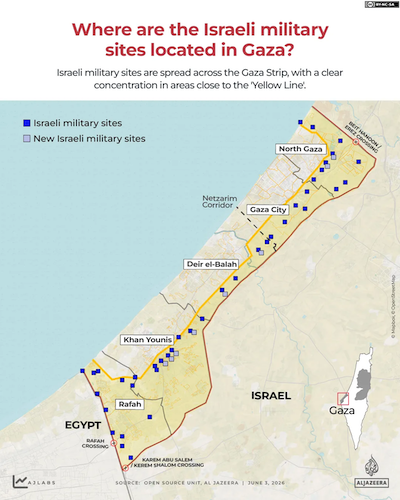
Notes on the Senior Administration's 'Fact Sheet'
To manufacture consent and justify their violent dismantlement of the Gaza Solidarity Encampment, UC San Diego senior administration employs coded language and racist, anti- Muslim bigoted tropes which parallel the rhetoric that has long legitimated violence against Palestinians and Black People in the U.S. As scholar Julie Peteet 169 has shown, these “linguistic practices, along with a generalized politics of nonrecognition, [have] long cast Palestinians as irrational aggressors and blamed them for compelling the violence inflicted upon them” — in the name of security and peace, these practices have authorized violence, surveillance, harassment, bigotry on the Palestinian (Muslim, Arab) as Other. 170, 171 Similar language has enabled violence against Black folks and a panoply of minoritized groups across the U.S. — defensive actions are cast as active resistance that forces violent response, criminalization, and banishment. 172, 173, 174
In reading the communications of UCSD senior administration, we show how this linguistic repertoire deflects institutional culpability while rendering the Encampment as illegitimate and thus disposable. We identify the following rhetorical tricks:
1. Portraying those imperiled by and protesting injustice as simultaneously ruthless and helpless; 175
2. Othering, dehumanizing, and criminalizing the targets of power as inherently irrational aggressors, thus deserving of and responsible for the violence inflicted upon them; 176
3. Constructing the innocence of privileged groups, minimizing their acts of violence as if, paradoxically, it was their safety and security under threat; 177
4. Presenting the institution’s goal as merely ‘keeping the peace’, eliding their own responsibility in creating the conditions in which peace was impossible (e.g., genocide, police action); 178
5. Using passive voice and the appeal to ‘fact’ to minimize racial bias, complicity, and violent decisions made by institutional actors 179
These rhetorical tricks guide the messaging of senior administration. In the ‘fact sheet’ 180, they appear as a series of decontextualized facts, misrepresentations, and outright lies about the Encampment and the senior administration’s response. Encampment participants are cast as irrational actors without clear goals and with whom dialogue was impossible (Trick 1) — despite the fact that the Encampment organizers had sought a meeting with the Chancellor through the Academic Senate Chair on the basis of clearly stated goals. The ‘fact sheet’ portrays Encampment participants strictly as the source of violence — a potential source of fire, potential attackers of the Student Health Center, potential aggressors against counter- protesters, potential disrupters of instruction. Through this they are blamed for the violence on May 6, despite the lack of evidence that any of these possibilities occurred or were remotely likely (Trick 2). The Encampment is held responsible for ‘escalating’ a counter-protest — as if it was the counter-protestors threatened, and not themselves the threat (Trick 3). The need to ‘restore’ peace to the campus was used as an excuse to ignore history — the history of protest, the history of repression of speech about Palestine, the history of UCSD's complicity in Israel's crimes, the history of Palestine itself — to assert that May 1 was the beginning, as the 'fact sheet' does, in much the same way that Israel falsely asserts that October 7, 2023 was the beginning to justify genocide (Trick 4). The 'fact sheet' portrays senior administration decision-making as seemingly logical and reasonable, in order to conceal their animus against anti-genocide Palestinian, Arab, BIPOC, Trans, Queer, Muslim, Jewish and Christian organizers. In passive voice, it renders the violent dismantlement of the Encampment as an objective, measured process that erases the agent of the action — rather than the unhinged result of an orchestrated plan to repress speech protesting the genocide and UCSD's complicity in it (Trick 5).
UCSD senior administration borrows from a well-worn playbook to justify racist, anti-Muslim conduct. Below, we provide a detailed accounting of how these linguistic tricks operate within the senior administration's 'fact sheet'.
The ‘Illegality’ of the Encampment
‘Fact sheet’ – “Within minutes, university representatives from the Office of the Vice Chancellor for Student Affairs and Campus Life hand-delivered notecards to participants explaining free expression rights and rules for campus and relevant state laws, including those for non-affiliates. Student Affairs staff members talked with participants individually, stating that the camp was illegal, and encouraging them to leave the site immediately.”
The ‘fact sheet’ asserts that, from Day 1, university representatives determined the encampment to be illegal, and that this had been communicated to participants "within minutes" of its formation. This claim is demonstrably false. Official, campus-wide email communications from the Chancellor do not mention any determination of illegality, only that the Encampment was in violation of campus policy — a common designation for protests throughout UCSD's history that did not result in sanction or arrests. It is not until Day 5 that these communications indicate the senior administration’s updated assertion that the Encampment was unlawful.
This assertion portrays the senior administration as the rational, communicative party, clearly communicating the risks of participation; by contrast, it insinuates that those participating were adventurist activists, acting in willful defiance of the law (Trick 2). Elsewhere, the 'fact sheet' records that "SAMs were told by one individual supportive of the encampment that the goal would be for arrests to take place" (but by who?). It identifies the Encampment in toto to be a form of 'civil disobedience' — that is, an action deliberately staged for the symbolic purpose of arrest (e.g., Rosa Parks). Nothing could be further from the truth. To anyone visiting, it was apparent that the Encampment was not a purely symbolic act; protesters were not sitting around waiting to be arrested. In light of the violent responses wrought upon encampments by other universities, it was a contingency that had to be planned for; but arrest was hardly the goal. Rather, the Encampment was a space of community-building and shared action: students speaking, teaching, and organizing towards what the senior administration would not. It was this deep, intellectual, collective discussion of the genocide — and UCSD’s complicity in it — that the senior administration set its repressive apparatus (disciplinary procedures, arrest) to destroy.
Further, this assertion implies the senior administration's tolerance in allowing the Encampment to remain standing for as long as it did, in spite of its purportedly 'illegal' status. This is a deflection of the enmity consistently displayed by the senior administration towards the Encampment, shown in their repeated efforts over the course of its existence to fabricate grounds for its illegality and thereby justify its dismantlement (Trick 4). The substantive activities of the Encampment were not illegal (consider, for instance, that the San Diego City Attorney declined to file criminal charges brought against students).
Perhaps aware of the weakness of its case, the 'fact sheet' is anxious to supplement 'illegality' by drawing expansive suspicion over other participants. In red-baiting fashion, for instance, it notes that “non-affiliates including members of the Black Panthers, Antifa, and the Communist Revolutionary Group arrived at the camp site” — a scare-tactic effort, devoid of evidence, to conjure some imagined threat in the mere naming of these groups, and notably racialized in its figuring of the Black Panthers (Trick 5). What it betrays is the consistent posture of senior administration: to maintain the unlawfulness of the encampment, at any cost, in order to silence it.
Encampment Liaisons
‘Fact Sheet’ – “Discussions with the encampment were increasingly difficult; there was no consistent person to communicate with, no one claimed to have any authority, and shifting representatives deflected responsibility and accountability for communications, actions, or follow-up.”
Communication with encampment liaisons is portrayed as “increasingly difficult” in order to elide the reality that, from its very outset, the four demands of the Encampment were utterly clear (see Section 2). The ‘fact sheet’ plays confused: it pretends not to know the stated goals of the Encampment, or their stated willingness to negotiate in a face-to-face meeting with Chancellor Khosla (as occurred, for instance, at UC Riverside and UC Berkeley). Encampment organizers were frustrated with the lack of engagement from senior administration. As noted above, a media liaison for the Encampment was quoted on May 4 by Fox 5 San Diego as lamenting "They haven't responded at all. We're hoping that they can come out and try to talk to the students, but for the past four days, we have heard nothing. It's really disappointing to see that they are out here trying to bring in people to try to close down the Encampment but they're not out here trying to listen to their students." 120
Encampment student organizers asked for a meeting with Khosla and he refused. It was senior administration that declined to take this route of negotiation. Unwilling to admit this, the 'fact sheet' instead focuses on portraying Encampment liaisons as confused and irrational (Trick 2), bemoaning for instance that “one camp participant emailed a demand list to university officials” but “later stated that they were not a decision-maker” — it blames this lack of a 'consistent' liaison for the senior administration's inability to engage the Encampment and its demands (Trick 4). But with no sign of good faith engagement, what was there to liaise over? What decisions were on the table? Similar to its false portrayal of the Encampment as civil disobedience, discussed above, the 'fact sheet' cherry picks select instances that deflect from the senior administration's own basic culpability in refusing to recognize or engage the Encampment (Trick 5).
Beyond this fabricated 'issue' of negotiation, the disingenuous construction of liaising is used to portray the Encampment as an imminent risk to safety and campus operations — that, for instance, it meant the Encampment was unable to coordinate accountably with senior administration over a 'safety plan'. But the safety and disruption concerns raised are ones imputed to the Encampment by the senior administration itself, in its effort to police the Encampment — namely, that the Encampment might block Library Walk, or access to the Student Health Center. Neither of these occurred; evidence, again, that Encampment participants were not seeking 'disruption' for its own sake. Imminent threat is constructed to justify the disproportionate response of the senior administration (Trick 4); consider that access to the Student Health Center was in fact blocked, on May 6, by the Chancellor's massive police action.
Safety
‘Fact sheet’ – “University leaders determined that waiting for something more dangerous to happen (e.g. fire in the camp, attack by outsiders seen at other campuses including UCLA just the week prior, etc.) was unconscionable. The safety of the entire campus — including the individuals in the encampment — required dismantling the illegal camp.”
‘Fact sheet’ – “On Sunday May 5 at 3pm, a scheduled and advertised counterprotest was planned at Library Walk... If a fight had broken out, it is likely that the campus’ security resources would have been overwhelmed.”
The ‘fact sheet’ culminates in May 4 as the dramatic ‘turning point’, after which the senior administration apparently had no choice but to act. Reviewing these claims, however, shows this temporal framing to be disingenuous — it constructs a threatening atmosphere that simply did not exist. For instance, the sheet points to the Encampment’s expansion “from approximately 11,000 sqf to 33,000 sqf” as one especially acute trigger, warranting response. The Encampment did expand, but this was a gradual and reasoned process, driven by students who joined in the Encampment’s cultural and educational events over its course, and in order to provide a safe space for Arab and Muslim students on campus that "encountered harassment, threats, and privacy invasion" (see May 4 timeline, Section 3). Note, as well, that the encampment had expanded into the open grove to its north — not onto Library Walk, or far down towards the Student Health Center. The Encampment simply was not the conspiratorial, disruption-focused group that the senior administration made them out to be.
Likewise, the ‘entry table’ — in place from the beginning — functioned as a (voluntary) opportunity to provide information for potential legal support (see above), and as a means to review and discuss the publicly stated community guidelines of the Encampment, which sought to ensure the safety of everyone in the Encampment and outside it. These guidelines were a measured response to the lack of protection from campus security, in light of the violence recently inflicted on encampments at other campuses. It was not an exclusionary check-point or sign of willful escalation, as the ‘fact sheet’ insinuates.
The Encampment is not responsible for the violence raised by counter-protestors. Nor can it be reasonably expected that the Encampment would simply allow counter-protestors to destroy it, as it happened at UCLA just prior, on April 30. In that case, security and police sat back for four hours; similarly, the ‘fact sheet’ itself admits that, on May 5, “if a fight had broken out, it is likely that the campus’ security resources would have been overwhelmed”. UC San Diego was legally obligated to provide protection for the Encampment from counter- protesters; the threat of violence from counter-protesters is not sufficient grounds to shut down a protest: the Heckler's veto 181. Given the lack of protection from campus, the actions taken by the Encampment to defend itself were reasoned and justified; materials like ‘plywood’, construed by the ‘fact sheet’ as a threat, are clearly legible as a matter of self- defense. The ‘fact sheet’ is quick to emphasize the resources drained by the 24/7 ‘emergency staffing’ of police for the Encampment — but, by the senior administration's own admission, this was not sufficient to handle the predictable counter-protesting. As Students for Justice in Palestine at UC San Diego put it at the time, "It is notable that Chancellor Khosla acknowledges the threat of violence from outside the Encampment, yet all of the senior administration's threats and denouncements have been directed at us rather than the outside instigators" (Trick 3).
In framing this 'issue' of safety, Encampment participants are portrayed as both ruthless and helpless (Trick 1). The 'fact sheet' claims Encampment participants "escalate[d]" and "provoke[d]" counter-protestors, falsely narrating them as malicious; in the next paragraph, it adopts a paternal tone, stating concern for campus safety "including the individuals in the encampment" to justify their violent deployment of UCPD, CHP, and Sheriffs officers to brutally dismantle the Encampment.
The senior administration’s failure to address this crucial issue of safety can help us understand why, for instance, the Encampment did not allow “entry to [fire] safety inspectors and two SAMs” — accompanied by police officers. In light of the senior administration's evident unwillingness to respect and protect the Encampment, Encampment organizers reasonably suspected this as an effort to provoke and fabricate justification for its dismantlement.
The antagonism imputed by the senior administration to the Encampment, we stress, in fact sits with the senior administration — shown in the inadequate protections provided, unwillingness to negotiate, and consistent efforts to fabricate justification for the Encampment's dismantlement.
Citation List
- 1
Students for Justice in Palestine at UC San Diego (2024) UC San Diego Students Launch Gaza Solidarity Encampment, Instagram, May 1. https://www.instagram.com/p/C6b7VunPv59/
- 2
Guardian Staff (2024) Protestors Establish Pro-Palestinian Encampment at UC San Diego, UCSD Guardian, May 1. https://ucsdguardian.org/2024/05/01/protestors-establish-pro-palestinia…
- 3
Guardian Staff (2024) Pro-Palestinian Encampment Continues into Second Day, UCSD Guardian, May 2. https://ucsdguardian.org/2024/05/02/pro-palestinian-encampment-continue…
- 4a4b
Thomas Murphy/Guardian Staff (2024) Updates – Police Sweep UCSD Solidarity for Gaza Encampment, UCSD Guardian, May 6. https://ucsdguardian.org/2024/05/06/daily-updates-ucsd-solidarity-for-g…
- 5
Students for Justice in Palestine at UC San Diego (2024) UC San Diego Students Launch Gaza Solidarity Encampment, Instagram, May 1. https://www.instagram.com/p/C6b7VunPv59/?img_index=2
- 6
United Nations Office for the Coordination of Humanitarian Affairs (2024) Hostilities in the Gaza Strip and Israel - Reported Humanitarian Impact, Fact Sheet, May 1. https://www.ochaopt.org/sites/default/files/Gaza_casualties_info-graphi…
- 7
Deena R. Hurwitz and Walter H White, Jr (2024) Recognizing Islamophobia, Anti- Palestinian Racism, and Antisemitism, American Bar Association Civil Rights and Social Justice Section, November 25. https://www.americanbar.org/groups/crsj/resources/human-rights/2024-nov…
- 8
UC San Diego (2024) UC San Diego Principals of Community, Archived on archive.org, May 1. https://web.archive.org/web/20240501104820/https://ucsd.edu/about/princ…
- 9a9b
UCSD Divest (2024) UCSD's Complicity: A Walking Tour Brochure and Map. https://ugc.production.linktr.ee/d3fd4ddf-fcb2-44a7-8e39-ded8d8da3f97_C…
- 10a10b
UCSD Divest (2024) UC Funds the War Machine. https://datastudio.google.com/reporting/9ceda675-da4b-4157-8584-a8011a5…
- 11
UCSD Divest (2024) Boycott, Divestment, Sanctions at University of California. https://docs.google.com/presentation/d/e/2PACX-1vQHFdeJaVJkEo2r4r6bGlYa…
- 12a12b
NYC Palestinian Youth Movement (2024) Columbia has Continually Refused to Listen to the Student Body When We Demand that They Divest from the Ongoing Genocide in Gaza, Instagram, April 17. https://www.instagram.com/p/C54bO1gNkqq/?hl=en
- 13
Dani Miskell (2024) As Encampments Dismantle Across US, UC San Diego Stands Their Ground, ABC 10 News San Diego, May 1. https://www.10news.com/as-encampments-dismantle-across-the-u-s-ucsd-sta…
- 14
Hannah Drake (2023) The Origin(s) of UC San Diego: Kumeyaay History and University Land Tenure, Undergraduate Honors Thesis, Department of Ethnic Studies, UC San Diego, Spring. https://escholarship.org/uc/item/4h07n2ts
- 15
Maya Wind (2024) Hebrew University: A Pillar of Israeli Colonialism, Mail and Guardian, April 29. https://mg.co.za/thought-leader/2024-04-29-hebrew-university-a-pillar-o…
- 16
Mustafa Fatih Yavuz (2017) Palestion's Al-Shaykh Muwannis Village: The Forgotten Story, Daily Sabah, September 21. https://www.dailysabah.com/feature/2017/09/21/palestines-al-shaykh-muwa…
- 17a17b
Maya Wind (2024) Towers of Ivory and Steel: How Israeli Universities Deny Palestinian Freedom, Verso Books.
- 18
Somdeep Sen (2024) Israeli Academia is Directly Complicit in the Crimes of the State, Al Jazeera English, September 10. https://www.aljazeera.com/opinions/2024/9/10/israeli-academia-is-direct…
- 19
Al Jazeera Staff (2024) How Israel has Destroyed Gaza's Schools and Universities, Al Jazeera English, January 24. https://www.aljazeera.com/news/2024/1/24/how-israel-has-destroyed-gazas…
- 20
This Week in Palestine Staff (2023) Sufian Abdul Rahman Othman Tayeh 1971-2023, This Week in Palestine Staff. https://thisweekinpalestine.com/sufian-abdul-rahman-othman-tayeh/
- 21
Institute of Palestine Studies Staff (2023) The Martyrdom of Khitam al-Wasefi, Documenting the Educide in the Gaza Strip, The Institute of Palestine Studies. https://gazaeducationsector.palestine-studies.org/en/node/3539
- 22
One Bold Idea Staff (2018) How Students Helped End Apartheid, One Bold Idea, https://www.universityofcalifornia.edu/news/how-students-helped-end-apa…
- 23
Christopher Canole and Renee Wenrick (1985) Students Strike, Rally, UCSD Guardian, May 9, page 7. https://lbrary.ucsd.edu/dc/object/bb2287802n
- 24
Jane Rosenberg (1985) Assembly Pushes Divestment Bills, UCSD Guardian, May 9, page 8. https://library.ucsd.edu/dc/object/bb2287802n
- 25
We the People Experimental Publishing Cooperative and UCSD Exposed Collective (1992) UCSD Exposed: Ruck the Feegents: A Pictorial History of Student Activism, pages 6-7. https://library.ucsd.edu/dc/object/bb64599016/_1.pdf
- 26
Jason Snell (1992) WRC March Yields Charges Of Misconduct, Damage, UCSD Guardian, April 9, page 1. https://library.ucsd.edu/dc/object/bb5154721v/_1.pdf
- 27
Melinda Hamilton (1992) Tucker Dismisses All Charges Against WRC, UCSD Guardian, April 13, page 1. https://library.ucsd.edu/dc/object/bb4267345r/_1.pdf
- 28
Marissa Lee (1992) WRC is Not a Four Letter Word, UCSD Guardian, May 4, page S4. https://library.ucsd.edu/dc/object/bb3618870f/_1.pdf
- 29
Luis Alvarez, Roberto Alvarez, Cutler Edwards, Stevie Ruiz and Elizabeth Sine (2010) Another University is Possible, University Readers.
- 30
Angela Chen (2010) Campus Reacts to Racial Slur, UCSD Guardian, February 22, page 1. https://library.ucsd.edu/dc/object/bb6485918s/_1.pdf
- 31
Angela Chen (2010) Party Foul: Offended Students and Administration Respond to Racially-Themed Frat Cookout, UCSD Guardian, Febr\uary 18, page 1. https://library.ucsd.edu/dc/object/bb81582834/_1.pdf
- 32
Angela Chen (2010) Teach-In Walks Out: Black Student Union and Supporters Ditch University Teach-In to Host Speakers of Their Own, UCSD Guardian, February 25, page 1. https://library.ucsd.edu/dc/object/bb17077164/_1.pdf
- 33
Angela Chen (2010) 'Shut It Down': Angry Students Take Over the Chancellor's Complex, Awaiting a Response to Their Demand that the University Cease Operations, UCSD Guardian, March 1, page 1. https://library.ucsd.edu/dc/object/bb7816984j/_1.pdf
- 34
Gabe Schneider (2017) The Compton Cookout: A Day Party to be Remembered (or Not), The Triton, page 1. https://triton.news/2017/02/compton-cookout-day-party-remembered-not/
- 35
Jacob Sutherland (2020) Remembering the Compton Cookout: Analyzing Our Coverage, UCSD Guardian, January 5, page 1. https://ucsdguardian.org/2020/01/05/remembering-the-compton-cookout-ana…
- 36
Taylor Sanderson (2015) Students Protest Nudity Laws at Free the Nipple Event, UCSD Guardian, May 20. https://ucsdguardian.org/2015/05/20/students-protest-nudity-laws-at-fre…
- 37
Balestra Entertainment (2015) Free the Nipple UCSD 2015, Youtube video (Explicit), May 21. https://www.youtube.com/watch?v=2ISs7SFSNYk
- 38
Craig Herrera (2015) Dozens Go Topless at UCSD to 'Free the Nipple', ABC 10 News, May 20. https://web.archive.org/web/20160413114502/http://www.10news.com/news/d…
- 39
Millie Root (2022) UAW Strikers Picket Line, UCSD Guardian, November 21, page 7. https://library.ucsd.edu/dc/object/bb29117140/_1.pdf
- 40
Cydney Macon (2024) ASUCSD Passes Divestment Resolution After Historic Pro- Palestinian Protest, The Triton. https://triton.news/2024/04/asucsd-passes-divestment-resolution-after-h…
- 41
Mike Davis, Kelly Mayhew and Jim Miller (2003) Under the Perfect Sun: The San Diego Tourists Never See, Seven Stories Press.
- 42
Dani Angulano (2024) UCLA Students Describe Violent Attack on Gaza Protest Encampment 'It was Terrifying', The Guardian, May 1. https://www.theguardian.com/us-news/2024/may/01/ucla-campus-violence-pr…
- 43
PBS and Associated Press Staff (2024) Police Fire Flash-Bangs, Detain Protesters as They Dismantle Pro-Palestinian Encampment at UCLA, PBS News, May 2. https://www.pbs.org/newshour/politics/police-fire-flash-bangs-detain-pr…
- 44a44b
Palestine Legal and The Center for Constitutional Rights (2015) The Palestine Exception to Free SpeechL A Movement Under Attack in the US. https://palestinelegal.org/the-palestine-exception
- 45
The Institute for the Understanding of Anti-Palestinian Racism (2026) Selected Forms of Anti-Palestinian Racism. https://antipalestinianracism.org/#forms-racism
- 46
Jairo I. Fúnez-Flores (2024). The Coloniality of Academic Freedom and the Palestine Exception. Middle East Critique, 33(3), 465–485. https://www.tandfonline.com/doi/full/10.1080/19436149.2024.2375918
- 47
Nahla Abdo (2022). The Palestine Exception, Racialization and Invisibilization: From Israel (Palestine) to North America (Turtle Island). Association for Critical Sociology, 49(6), 967-989. https://journals.sagepub.com/doi/epub/10.1177/08969205221131315
- 48
Steven Salaita (2024). The Free Speech Exception to Palestine. Middle East Critique, 33(3), 361-375. https://www.tandfonline.com/doi/abs/10.1080/19436149.2024.2342667
- 49
Guardian Staff (2024) Updates - Police Sweep UCSD Solidarity for Gaza Encampment, UCSD Guardian, May 6. https://ucsdguardian.org/2024/05/06/daily-updates-ucsd-solidarity-for-g…
- 50
CAIR (2026) Designated: CAIR's 2025 Hostile Campus Ratings Report, Monitoring and Combating Islamophobia, A Project of the Council on American-Islamic Relations. https://islamophobia.org/special-reports/designated-cairs-2025-hostile-…
- 51
Peace San Diego (2026) UCSD Designated a Hostile Campus, Youtube Video, April 3. https://www.youtube.com/watch?v=ijwtkuWOe_8
- 52
Students for Justice in Palestine at UC San Diego (2024) Open Letter from SJP to UCSD Students and Administration, UCSD Guardian, October 3. https://ucsdguardian.org/2024/10/03/community-response-open-letter-from…
- 53
Islamic Center of San Diego (2026) Community Update from the Islamic Center of San Diego, June 22. https://www.icsd.org/
- 54
Muhammad Yousef (2026) Making Sense of Islamophobia, UCSD Guardian, May 26. https://ucsdguardian.org/2026/05/26/making-sense-of-islamophobia/
- 55
Adam Abumughaiseeb (2026) Shooting at Islamioc Center of San Diego Kills Three People, UCSD Students Gather to Honor Victims, UCSD Guardian, May 26. https://ucsdguardian.org/2026/05/26/shooting-at-islamic-center-of-san-d…
- 56
Ana Paula Mendias-Navarrete (2024) Council on American-Islamic Relations Hosts Press Conference at UC San Diego About Anti-Palestinian and anti-Arab Racism, UCSD Guardian, October 17. https://ucsdguardian.org/2024/10/17/council-on-american-islamic-relatio…
- 57
Rosalina Diaz (2024) Decolonizing Ethnography: A Reimagined Framework for Teaching Radical Ethnography, Teaching Tools, Fieldsights, February 15. https://www.culanth.org/fieldsights/decolonizing-ethnography-a-reimagin…
- 57
Rosalina Diaz (2024) Decolonizing Ethnography: A Reimagined Framework for Teaching Radical Ethnography, Teaching Tools, Fieldsights, February 15. https://www.culanth.org/fieldsights/decolonizing-ethnography-a-reimagin…- for-conducting-radical-ethnography
- 58a58b58c
Jeffrey S. Juris (2007) Practicing Militant Ethnography with the Movement for Global Resistance in Barcelona, in Stevphen Shukaitis and David Graeber, with Erika Biddle, eds., Constituent Imagination: Militant Investigations // Collective Theorization, AK Press, 164-176. https://static1.squarespace.com/static/53fde28ee4b0f7be79e00d95/t/53fe9…
- 59a59b
Klee Benally et al (2014) Accomplices Not Allies: Abolishing the Ally Industrial Complex, Indigenous Action Media. https://www.indigenousaction.org/accomplices-not-allies-abolishing-the-…
- 60
Robert Lee and Tristan Ahtone (2020) Land Grab Universities: Expropriated Indigenous Land is the Foundation of the Land-Grant University System, High Country News, March 30. https://www.hcn.org/issues/52-4/indigenous-affairs-education-land-grab-…
- 61
Dian Million (2009) Felt Theory: An Indigenous Feminist Approach to Affect and History, Wicazo Sa Review, 24(2), Project MUSE, 53-76. https://dx.doi.org/10.1353/wic.0.0043
- 62
ABC 10 News (2024) WATCH LIVE: UCSD Encampment, Youtube video, May 1. https://www.youtube.com/watch?v=VVlYFYuKUHE
- 63
CBS 8 San Diego (2024) UCSD Pro-Palestinian Encampment | Day 2, Youtube video, May 2. https://www.youtube.com/watch?v=uyw1uhG2W9o
- 64
UCSD Faculty (2024) Faculty Testimony on the UCSD Gaza Encampment, May 6. https://docs.google.com/document/d/1aHgGjddDhgE0-IDxsTUf1Nk_n1F3n0nhF2v…
- 65
UC San Diego (2026) UC San Diego Principles of Community. https://ucsd.edu/about/principles.html
- 67
Students for Justice in Palestine at UC San Diego (2024) Imam Tom Night 2, Instagram, May 3. https://www.instagram.com/p/C6hXQ_XuqYr/
- 68
Students for Justice in Palestine at UC San Diego (2024) Linda Sarsour Night One, Instagram, May 1. https://www.instagram.com/p/C6c-lMsrWtG/
- 69
UCSD Divest Coalition (2024) Linktree. https://linktr.ee/ucsd.divest
- 70
UCSD Divest Coalition (2024) UCSD's Complicity: A Walking Tour Brochure. https://ugc.production.linktr.ee/d3fd4ddf-fcb2-44a7-8e39-ded8d8da3f97_C…
- 71
UCSD Divest Coalition (2024) UCSD's Complicity: A Virtual Tour. https://ion.cesium.com/stories/viewer/?id=59db8cdc-fd53-4c12-a1a1-6b56e…
- 72
UC Divest Coalition (2024) Boycott Divestment and Sanctions at the University of California. https://docs.google.com/presentation/d/e/2PACX-1vQHFdeJaVJkEo2r4r6bGlYa…
- 73
Students for Justice in Palestine at UC San Diego (2024) Our Demands, Instagram, May 1. https://www.instagram.com/p/C6b7VunPv59/?img_index=3
- 74
Islamic Center of San Diego (2026) ICSD Victim and Family Support Fund. https://goodbricks.org/campaign/icsd.org/official-icsd-victim---family-…
- 75
Peace San Diego (2024) UCSD's Complicity in Genocide Tour, Youtube video, June 3. https://www.youtube.com/watch?v=oTbOQ0A5EuY
- 76
Donald H Harrison (2024) City Attorney Declines Charges for 64 Anti-Israel Protesters Arrested at UCSD, Prompting Backlash, Times of San Diego, November 1. https://timesofsandiego.com/crime/2024/11/01/city-attorney-declines-cha…
- 77
Katie Hyson and Matthew Bowler (2024) 'It’s David versus Goliath': UCSD Student Protestors Challenge Discipline Charges, KPBS, October 21. https://www.kpbs.org/news/education/2024/10/21/its-david-versus-goliath…
- 78
UCSD Faculty for Justice in Palestine and Council on American Islamic Relations California (2026) Press Release - UCSD Designated a Hostile Campus: Administration Doubles Down on New Recognition, April 2. https://cryptpad.fr/file/#/2/file/VO0m-ipf-55GCmr-OCw3nCOY/
- 79
UC Office of the President (2024) University of California Statement on Divestment, April 26. https://www.universityofcalifornia.edu/press-room/university-california…
- 80
One Bold Idea (2018) How Students Helped End Apartheid. https://www.universityofcalifornia.edu/news/how-students-helped-end-apa…
- 81
M.G. Perez, Matthew Bowler and Bennett Lacy (2024) UCSD Students Establish Pro- Palestinian Encampment on Campus, KPBS, May1. https://www.kpbs.org/news/education/2024/05/01/ucsd-students-establish-…
- 82
Dani Miskell (2024) As Encampments Dismantle Across US, UC San Diego Stands Their Ground, ABC 10 News, May 2. https://www.10news.com/as-encampments-dismantle-across-the-u-s-ucsd-sta…
- 83
Debbie L. Sklar (2024) UCSD Students Establish Encampment, USD Students Lead Gaza Memorial, Times of San Diego, May 1. https://timesofsandiego.com/politics/2024/05/01/ucsd-students-establish…
- 84
CBS San Diego (2024) UCSD Encampment Says They Are Focused on Peace, Youtube Video, May 3. https://www.youtube.com/watch?v=6W3VFY0HKjc&t=20
- 85
Danielle Dawson (2024) ‘Normal Operations’ Resume at UC San Diego After Dozens of Protestors Arrested, Fox 5 News, May 7. https://fox5sandiego.com/news/local-news/normal-operations-resume-at-uc…
- 86
Laura Acevedo (2024) Shabbat Celebration at UCSD Gaza Solidarity Encampment, ABC 10 News, May 3. https://www.10news.com/news/local-news/shabbat-celebration-at-the-ucsd-…
- 87
Danielle Dawson and Christelle Koumoué (2024) 'Gaza Solidarity' Encampment at UC San Diego Enters Third Day, Fox News San Diego, May 4. https://fox5sandiego.com/news/local-news/gaza-solidarity-encampment-at-…
- 89
Philip Salata (2024) UCSD Protesters Pitch Camp in Nationwide Movement for Palestine, inewsource, May 2. https://inewsource.org/2024/05/02/ucsd-students-protest-israel-divestme…
- 90
David Graeber (2002) The New Anarchists, New Left Review, 13(6), 61-73. https://theanarchistlibrary.org/library/david-graeber-the-new-anarchists
- 91a91b
Students for Justice in Palestine at UC San Diego (2024) Encampment Safety, Instagram, May 1. https://www.instagram.com/p/C6b7VunPv59/?img_index=4
- 92a92b
Students for Justice in Palestine at UC San Diego (2024) Community Guidelines, Instagram, May 1. https://www.instagram.com/p/C6b7VunPv59/?img_index=6
- 93
Students for Justice in Palestine at UC San Diego (2024) Day 1 Program, Instagram, May 1. https://www.instagram.com/p/C6cLJiSSoNQ/
- 94
Guardian Staff (2024) Protesters Establish Pro-Palestinian Encampment at UC San Diego, UCSD Guardian, May 1. https://ucsdguardian.org/2024/05/01/protestors-establish-pro-palestinia…
- 95a95b95c
Philip Salata (2024) UCSD Protesters Pitch Camp in Nationwide Movement for Palestinian Life, inewsource, May 2. https://inewsource.org/2024/05/02/ucsd-students-protest-israel-divestme…
- 96
M.G. Perez, Matthew Bowler, Bennet Lacy (2024) UCSD Students Establish Pro- Palestinian Encampment on Campus, KPBS. May 1. https://www.kpbs.org/news/education/2024/05/01/ucsd-students-establish-…
- 97
Boycott, Divestment and Sanctions Movement (2026) Palestinian Campaign for the Academic and Cultural Boycott of Israel. https://bdsmovement.net/pacbi
- 98a98b
Associated Students UCSD Office of Equity, Diversity and Inclusion )2024) Gaza Solidarity Encampments On-Campus: Immediate Information Release, Instagram, May 1. https://www.instagram.com/p/C6cwiE7rIHk/
- 99
Jewish Voice for Peace San Diego (2024) Professor Gary Fields at the UCSD Gaza Solidarity Encampment Video (our transcription), May 1. https://www.instagram.com/reel/C6c0S7wLuEe/
- 100
Databases for Palestine (2024) Students from Gaza Thanking Students in the US, Genocide.live (archive), May 1. https://genocide.live/223
- 101
Databases for Palestine (2024) Palestinian Children Created a Makeshift Swing from Collapsed Power Lines, Genocide.live (archive), May 1. https://genocide.live/2649
- 102
Databases for Palestine (2024) Israeli Forces Opened Fire at Two Men, Stripped Them, and Tortured Them While They Were Attempting to Escape From Gaza City, Genocide.live (archive), May 1. https://genocide.live/32615
- 103
Databases for Palestine (2024) Digging Baby Juri Out of the Rubble, Genocide.live (archive), May 1. https://genocide.live/221
- 104
Students for Justice in Palestine at UC San Diego (2024) Day 2 Program, Instagram, May 2. https://www.instagram.com/p/C6elOtqvHn1/
- 105
CBS 8 Staff (2024) UCSD Pro-Palestinian Encampment | Day 2, CBS 8 News San Diego, May 2. https://www.cbs8.com/article/news/local/ucsd-encampment-day-2/509-e66cb…
- 106
M.G. Perez and Matthew Bowler (2024) UC San Diego Protesters Say They're Committed to Keeping the Peace, KPBS, May 2. https://www.kpbs.org/news/education/2024/05/02/uc-san-diego-protesters-…
- 107
Students for Justice in Palestine at UC San Diego and Jewish Voice for Peace at UC San Diego (2024) Statement on the Cancellation of Sun God, Instagram, May 2. https://www.instagram.com/p/C6fowJcN9l4/?img_index=2
- 108
Databases for Palestine (2024) Testimony of a Released Palestinian About Torture and Humiliation Endured in Israeli Detention Camps, Genocide.live, May 2. https://genocide.live/32616
- 109
Databases for Palestine (2024) Children performing Dabke to بلدي يا بلدي غزه in Nuseirat Refugee Camp, Genocide.live, May 2. https://genocide.live/236
- 110
Students for Justice in Palestine at UC San Diego (2024) Day 3 Program, Instagram, May 2. https://www.instagram.com/p/C6fuFuEuJO7/
- 111
OB Rag (2024) UCSD Jewish Faculty and Students Stand in Solidarity with Campus Protest for Gaza, Now in 3rd Day, OB Rag, May 3. https://obrag.org/2024/05/ucsd-jewish-faculty-and-students-stand-in-sol…
- 112
ABC 10 News San Diego (2024) Shabbat celebration at the UCSD Gaza solidarity encampment, Youtube video, May 3. https://www.youtube.com/watch?v=oKNv9EMdXLo
- 113
Al Jazeera Staff (2024) 'Hind Hall': How Columbia's Hamilton Hall Became Its Signature Protest Hub, Al Jazeera English, May 1. https://www.aljazeera.com/news/2024/5/1/columbias-hamilton-hall-a-histo…
- 114
Macklemore (2024) Hinds Hall, Youtube video, May 9. https://www.youtube.com/watch?v=ITVIlr5jUMw
- 115
Laura Acevedo (2024) UC San Diego Palestinian Students Celebrate Graduation Off- Campus, ABC 10 News, June 14. https://www.10news.com/news/local-news/uc-san-diego-palestinian-student…
- 116
Databases for Palestine (2024) Mustafa, Age 12, Who Lost Both His Legs When Israel Bombed His Home, Sells Water Hoping to Buy Artificial Legs, Genocide.live. May 3. https://genocide.live/250
- 117
Databases for Palestine (2024) Remembrance One of the Many Palestinian Journalists Murdered by Israel - Saeed Al-Taweel, Genocide.live. May 3. https://genocide.live/5945
- 118
Databases for Palestine (2024) Israeli Occupation Forces Using an Innocent Civilian as a Human Shield in Gaza, Genocide.live. May 3. https://genocide.live/17313
- 119
Students for Justice in Palestine at UC San Diego (2024) Day 4 Program, Instagram, May 3. https://www.instagram.com/p/C6iVOh0Oypn/
- 120a120b
Fox 5 San Diego (2024) Tensions rise on Day 4 of San Diego Protests, Youtube video, May 4. https://www.youtube.com/watch?v=dz3RkzKkcaQ
- 121
Students for Justice in Palestine at UC San Diego, UCSD Divest, Palestinian Youth Movement San Diego and Jewish Voice for Peace-San Diego Students (2024) Our Statement, Instagram, May 4. https://www.instagram.com/p/C6kT3PWJQYj/
- 122
Associated Students at UCSD Senate (2024) Affirming Support for Student Demands, Instagram, May 4. https://www.instagram.com/p/C6k4qb_u0_q/
- 123
Democracy Now! 'People Could Have Died': Police Raid UCSD Gaza Protest after Pro- Israeli Mob Attacked Encampment, Youtube video, May 2. https://www.youtube.com/watch?v=lmekbcw-_Vg
- 124
Gary Fields (2025) ERASED! The Eradication of Encampment Protest at UCSD, UCSD Guardian, January 14. https://ucsdguardian.org/2025/01/14/erased-the-eradication-of-encampmen…
- 125
Databases for Palestine (2024) Young Girl Selling Clothes in a Market to Support Her Family after Israel Killed Her Brothers, Genocide.live. May 4. https://genocide.live/243
- 126
Databases for Palestine (2024) Haneen Hamdouna, A Journalist from Gaza, Explains Fear of Identifying as Press, Genocide.live. May 4. https://genocide.live/244
- 127
Databases for Palestine (2024) Palestinian Prisoner Abducted by the Israeli Army from Nasser Hospital in Khan Yunis, Describes the Torture He Experienced, Genocide.live. May 4. https://genocide.live/32763
- 128
Students for Justice in Palestine at UC San Diego (2024) Day 5 Program, Instagram, May 4. https://www.instagram.com/p/C6k1QewOIuU/
- 129a129b
M.G. Perez and Matthew Bowler (2024) UC San Diego Encampment for Palestine Faces Counter-Demonstration Supporting Israel, KPBS, May 5. https://www.kpbs.org/news/education/2024/05/05/uc-san-diego-encampment-…
- 130
Students for Justice in Palestine at UC San Diego, UCSD Divest, Palestinian Youth Movement San Diego, Party for Socialism and Liberation and Jewish Voice for Peace- San Diego Students (2024) Our Statement, Instagram, May 5. https://www.instagram.com/p/C6mx_4mPXHg/
- 131
Several People Drowned Attempting to Retrieve Food Aid Dropped in the Ocean off Gaza Beach, Genocide.live. May 5. https://genocide.live/239
- 132
Databases for Palestine (2024) Israel Bombs the Ishteiwi House, Next to Tents of Displaced People, in Rafah, Genocide.live. May 5. https://genocide.live/245
- 133
Databases for Palestine (2024) Mourning of Journalist Salem Abu Toyour Killed Along with his Son Ahmad in IDF Airstrike, Genocide.live. May 5. https://genocide.live/1746
- 134
Databases for Palestine (2024) Man Who Lost his Legs When Israel Bombed his House, Surrounded by his Family, Genocide.live. May 5. https://genocide.live/242
- 135
Students for Justice in Palestine at UC San Diego (2024) Day 6 Program, Instagram, May 5. https://www.instagram.com/p/C6ndrw_OPJQ/
- 136
Jermaine Ong (2024) Dozens Arrested on UCSD Campus as Law Enforcement Dismantle Encampment, ABC 10 News, May 6. https://www.10news.com/news/local-news/law-enforcement-officers-order-e…
- 137
Robert E. Continetti (2024) Announcement of Remote Instruction, Office of the Senior Associate Vice Chancellor for Academic Affairs, May 6. https://adminrecords.ucsd.edu/Notices/2024/2024-5-6-1.html
- 138
Gary Robbins, Karen Kucher and Teri Figueroa (2024) Police Crackdown on Prop- Palestinian Protest at UC San Diego Leads to Dozens of Arrests, Criticism, San Diego Union-Tribune, May 6. https://www.sandiegouniontribune.com/2024/05/06/police-crackdown-on-pro…
- 139
Databases for Palestine (2024) Nighttime Bombing and Flares in Rafah as the Ground Invasion Begins, Genocide.live, May 6. https://genocide.live/264
- 140
Databases for Palestine (2024) Families Fleeing Eastern Rafah, However They Can, Genocide.live, May 6. https://genocide.live/254
- 141
Databases for Palestine (2024) Al-Qahera News Documenting the IDF Attacking an Aid Warehouse, During a Famine, at the Rafah Crossing, Genocide.live, May 6. https://genocide.live/262
- 142
Databases for Palestine (2024) Carrying a Wounded Girl to Al Kuwait Hospital After the House She was in was Bombed by Israel, Genocide.live, May 6. https://genocide.live/266
- 143
Databases for Palestine (2024) The Aftermath from the IDF Bombing of a Home at Night, Genocide.live, May 6. https://genocide.live/255
- 144
Databases for Palestine (2024) Israelis Destroying Aid and Trucks Meant for Starving People in Gaza, at the Latrun Interchange, Genocide.live, May 6. https://genocide.live/267
- 145
Databases for Palestine (2024) Israelis Dancing as they Block Food at the Latrun Interchange, Genocide.live, May 6. https://genocide.live/275
- 146
Databases for Palestine (2024) Satellite Imagery Shows IDF Continuing Use of Cancer Hospital as a Military Base, Genocide.live, May 6. https://genocide.live/37204
- 147
Databases for Palestine (2024) Doctors Treat a Crying Boy, Who was Bombed by Israel, in a Tent at the Kuwaiti Specialty Hospital, Genocide.live, May 6. https://genocide.live/288
- 148
Vivian Dueker, Raymond Tran and Carter Castillo (2024) Voices from Inside the Encampment, UCSD Guardian, June 16. https://ucsdguardian.org/2024/06/16/voices-from-inside-the-encampment/
- 149
UC San Diego Graduate Students (2024) Statement from UCSD Graduate Students Condemning UCSD’s Response to Student Protest, The Triton, May 7. https://triton.news/2024/05/ucsd-graduate-students-condemn-protest-resp…
- 150
246 UCSD Faculty (2024) Faculty Testimony on the UCSD Gaza Encampment, May 6. https://docs.google.com/document/d/1aHgGjddDhgE0-IDxsTUf1Nk_n1F3n0nhF2v…
- 151
San Diego Faculty Association (2024) SDFA Statement on Student Protests. https://docs.google.com/forms/d/e/1FAIpQLSfAJeLbTxFkkJ6NHxECD8h7GtmPHsm…
- 152
Ethnic Studies Department Faculty (2024) Press Release: UCSD Faculty Call for Chancellor’s Resignation, May 6. https://cryptpad.fr/pad/#/2/pad/view/8BZRqWqVETf6t8BX1u+lLsnOvFTj1-NKqu…
- 153
Department of Communication Faculty (2024) Statement on the Events of May 6, 2024. https://communication.ucsd.edu/about/department-statements1.html#statem…
- 154
Members of the UCSD Writing Community (2024) You Wrote Them in the Cruelest Way, UCSD Guardian, June 4. https://ucsdguardian.org/2024/06/04/statement-from-the-uc-san-diego-wri…
- 155
UC San Diego Food Cooperative, General Store Cooperative, KSDT Radio, Che Cafe Collective, and Groundwork Books Collective (2024) Co-Op Union and KSDT Statement, The Triton, May 13. https://triton.news/2024/05/submission-co-op-union-ksdt-radio-statement/
- 156
Alex Reinsch-Goldstein (2025) UCSD Remembers: The Gaza Solidarity Encampment, UCSD Guardian, May 5. https://ucsdguardian.org/2025/05/05/ucsd-remembers-the-gaza-solidarity-…
- 157
Akram Al-Satarri (2024) Democracy Now! with Amy Goodman and Juan González, May 14. https://www.democracynow.org/2024/5/14/akram_al_satarri
- 158
The Palestinian Centre for Human Rights, Al Mezan and Al-Haq (2024) Urgent Call: Palestinian Human Rights Organizations Demand Concrete Action to Halt Impending Massacre Amid Rafah Ground Invasion, Al-Haq, May 8. https://www.alhaq.org/advocacy/22990.html
- 159
ActionAid, Action Against Hunger, American Friends Service Committee (AFSC), Amnesty International, A.M. Qattan Foundation. Anera, Churches for Middle East Peace (CMEP), DanChurch Aid (DCA), Humanity & Inclusion/ Handicap International (HI), IM Swedish Development Partner, INTERSOS, Médecins du Monde International Network, Mennonite Central Committee , Mercy Corps, Norwegian Church Aid (NCA), Norwegian People’s Aid, Oxfam, Plan International, Relief International, War Child Alliance (2024) World Leaders Fail to Act as Israeli Invasion of Rafah Worsens Humanitarian Catastrophe, Amnesty International, May 15. https://www.amnesty.org/en/latest/news/2024/05/world-leaders-fail-to-ac…
- 160
Francesca Albanese, Tomoya Obokata, Cecilia M Bailliet, Gina Romero, Reem Alsalem, Pedro Arrojo Agudo, Bina D’Costa, Dominique Day, Dorothy Estrada Tanck, Laura Nyirinkindi, Claudia Flores, Ivana Krstić, Haina Lu, George Katrougalos, Michael Fakhri, Siobhán Mullally, Ashwini K.P., Tlaleng Mofokeng, Balakrishnan Rajagopal, Paula Gaviria Betancur, Olivier De Schutter, Margaret Satterthwaite and Farida Shaheed (2024) Israel’s Rafah Invasion Must Stop Now, Say UN experts, Press Release, United Nations Office of the High Comissioner on Human Rights, May 10. https://www.ohchr.org/en/press-releases/2024/05/israels-rafah-invasion-…
- 161
Michael Mourshabeck (2024) Rafah Invasion Was Once Biden’s “Red Line” — But Israel Continues to Cross It, Truthout, May 28. https://truthout.org/articles/rafah-invasion-was-once-bidens-red-line-b…
- 162
Al Jazeera Staff (2024) ICJ Orders Israel to Halt Its Offense on Rafah, Gaza i New Ruling, Al Jazeera, May 24. https://www.aljazeera.com/news/2024/5/24/icj-orders-israel-to-halt-its-…
- 163
Amnesty International (2024) Amnesty International Investigation Concludes Israel is Committing Genocide Against Palestinians in Gaza, Amnesty International, December 5. https://www.amnesty.org/en/latest/news/2024/12/amnesty-international-co…
- 164
Human Rights Watch (2024) Israel’s Crime of Extermination, Acts of Genocide in Gaza. Human Rights Watch, December 19. https://www.hrw.org/news/2024/12/19/israels-crime-extermination-acts-ge…
- 165
UN Independent International Commission of Inquiry on the Occupied Palestinian Territory, including East Jerusalem, and Israel (2025) Israel has Committed Genocide in the Gaza Strip, UN Commission Finds, United Nations Office of the High Comissioner on Human Rights, September 16. https://www.ohchr.org/en/press-releases/2025/09/israel-has-committed-ge…
- 166
B'Tselem: The Israeli Information Center for Human Rights in the Occupied Territories (2025) Our Genocide, B'Tselem, July. https://www.btselem.org/publications/202507_our_genocide
- 167
United Nations Office for the Coordination of Humanitarian Affairs (2026) Hostilities in the Gaza Strip and Israel - Reported Humanitarian Impact, Fact Sheet, July 29. https://www.ochaopt.org/content/reported-impact-snapshot-gaza-strip-29-…
- 168
Yosra Aklouk (2026) ‘Creeping Death’: Israel Weaponizes ‘Yellow Line’ to Annex Gaza, Al Jazeera, July 22. https://www.aljazeera.com/news/2026/7/22/creeping-death-israel-weaponises-yellow-line-to-annex-gaza
- 169
Julie Peteet (2016) Language Matters: Talking about Palestine, Journal of Palestine Studies, 45(2), 24-40. https://doi.org/10.1525/jps.2016.45.2.24
- 170
Edward Said (1978) Orientalism, Pantheon Books.
- 171
Karen Stollznow (2020) Terrorists, Fanatics and Extremists: The Language of Anti-Muslim Prejudice, Globe, 11, 1-25. https://doi.org/10.5278/ojs.globe.v11i.6281
- 172
Akwasi Owusu-Bempah (2017) “Race and Policing in Historical Context: Dehumanization and the Policing of Black People in the 21st Century” https://doi.org/10.1177/1362480616677493
- 173
Omavi Shukur (2023) The Criminalization of Black Resistance to Capture and Policing, Theoretical Criminology, 21(1), 23-34. https://www.bu.edu/bulawreview/files/2023/04/SHUKUR.pdf
- 174
Harsha Walia (2021) Border and Rule: Global Migration, Capitalism, and the Rise of Racist Nationalism, Haymarket Books.
- 175
Leo Löwenthal and Norbert Guterman (1949) Prophets of Deceit: A Study of the Techniques of the American Agitator, Harper and Brothers.
- 176
Lisa Marie Cacho (2012) Social Death: Racialized Rightlessness and the Criminalization of the Unprotected, NYU Press.
- 177
Dylan Rodríguez (2020) White Reconstruction: Domestic Warfare and the Logics of Genocide, Fordham University Press.
- 178
Stuart Hall, Chas Critcher, Tony Jefferson, John Clarke, Brian Roberts (1979) Policing the Crisis: Mugging, the State, and Law and Order, Bloomsbury Publishing.
- 179
Jonathan Moreno-Medina, Aurélie Ouss, Patrick Bayer and Bocar A. Ba (2025) Officer- Involved: The Media Language of Police Killings, The Quarterly Journal of Economics, 140(2), 1525-1580. https://doi.org/10.1093/qje/qjaf004
- 180
UC San Diego Senior Administration (2024) Encampment Fact Sheet, May 9. https://keyissues.ucsd.edu/israel-hamas-war/encampment-fact-sheet.html
- 181
Former Prisoner (2025) The Return of the Hecker's Veto, Inside Time, December 1. https://insidetime.org/mailbag/the-return-of-the-hecklers-veto/