
In this section, we describe the Encampment through a series of lenses, ways of viewing and experiencing this transformative physical and discursive space:
1) the physical layout and functioning of the Encampment;
2) the Encampment as a place of education and research about the genocide and the settler colonial occupation of Palestine and UCSD's complicity in both;
3) The Encampment as a place to advocate for change at UCSD;
4) The Encampment as a communal space of mutual support;
5) The Encampment as a space for communicating the pain and horror of the genocide and the possibilities for liberation, in Palestine, at UCSD and elsewhere, to the UCSD community and to media via signs, chants, interviews, etc.;
6) The Encampment as a place for discussing, practicing and sharing diverse cultural and religious traditions; and
7) The Encampment as an organizing space under pressure - from senior administration hostile messaging, from police and security, from surveillance and from counter-protesters - requiring a very high level of discipline, communication and organizing among its members, a space ultimately violently dismantled on May 6.
1) Physical Layout
We begin with an overall view of what the Encampment was like, from our perspective. The physical layout of the encampment on May 1, as seen from a news helicopter, can be viewed to the right 62. (The three pop-up tents in the foreground on Library Walk were not affiliated with the Encampment.)
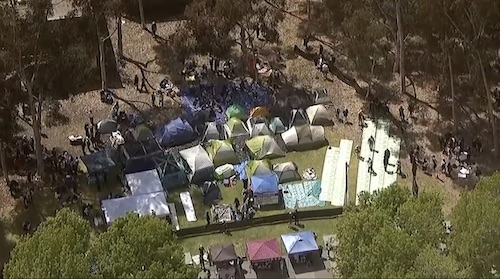
The encampment was located on an unused area of grass, wood chips and soil adjacent to Library Walk, which often is referred to as UCSD's Town Square. This location allowed students their right to expression at a place easily visited by the community, but also not interfering with students, staff and faculty going about their day amidst a genocide. The construction of the Encampment was quiet, swift and organized, marking clear boundaries and an entrance.
The Encampment footprint was outlined with black plastic tarp material strung between wooden stakes. Prayer rugs for Muslim prayer were located at the north end of the Encampment (towards Geisel Library). The eastern boundary of the Encampment was about 15 feet from Library Walk. This boundary contained signs, banners, photos from Palestine, and displays, neatly arranged and all easily visible from Library Walk. At approximately the center of this boundary was a speaker's canopy from which teach-ins, lectures and other events were conducted. Meeting canopies and tents, a medics tent and other communal spaces were located in the middle, west from the the eastern boundary structures, and residence tents generally were located at the west end of the Encampment. A kitchen and food distribution area was near the back of the Encampment, with tables, sanitation, and a set-up allowing for food safety protocols to be easily managed.
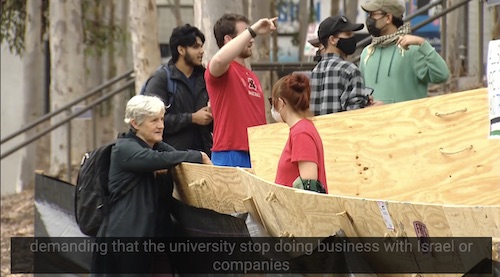
Initially, the Encampment entrance was located at the southeast corner of the Encampment. The entrance was moved to the northeast corner of the Encampment to facilitate security. Volunteer security personnel were located around the periphery of the Encampment 24 hours per day to ensure the safety of those inside and outside the Encampment.
In addition to daily planned activities, speakers and prayers, students, faculty, families and children came to visit and learn at the Encampment. Members of the Encampment came to the perimeter to talk with visitors about their protest, demands and the devastating statistics of the genocide's destruction of precious life, land, histories, and futures. 63

2) Education and Research
The student-organized Encampment was a space where intense agony and grief were turned into peaceful action. It was a site of education, research and community engagement about the genocide and its connections to the students’ university, thereby contributing to the mission of UCSD. The point was not to get arrested, but rather to carry out educational, research and community engagement actions that the senior administration was actively trying to suppress; the Encampment was not civil disobedience, it was direct action with specific demands. Likewise, signs reflected these demands, some concise and clear in their call: "Stop Arming Israel."
Throughout the duration of the Encampment, faculty gathered at the cement blocks outside of the northeast corner of the Encampment. Faculty used this location as a meeting place to share conversation, make zines, and to prepare for, practice and provide teach-ins. On May 6, eighty-six UCSD Faculty who visited the Encampment (also endorsed by 160 faculty who did not) testified that “the encampment was a beautiful community space; for some of us the most beautiful community, cultural and educational space we have ever seen in several decades at UC San Diego.” 64 Faculty were carrying out UCSD's Principles of Community that expect faculty to protect students and to “reject acts of discrimination based on race, ethnicity, sex, gender identity, age, disability, sexual orientation, religion, and political beliefs”. The Principles go even further, urging community members to “confront and appropriately respond to such acts.” 65
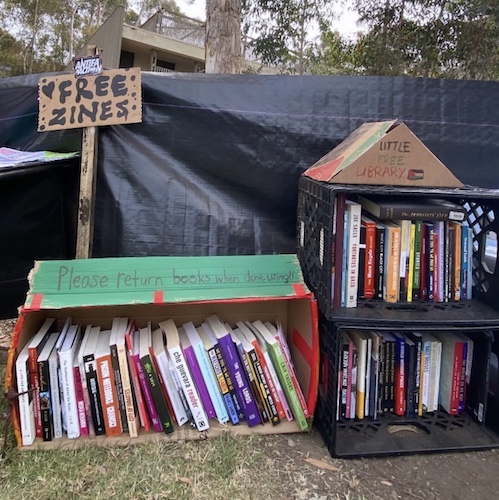
Making it clear that the Encampment was meant to be a collaborative and open educational space, faculty, students, and community members set up a "little free library" with a sign that directed borrowers "Please return books when done using!!"
Faculty and community leaders came to the Encampment to educate students on topics such as the surveillance state and political strategy. 67, 68 For example, the Day 1 program included teach-ins on the history of student movements and on the history of May Day.
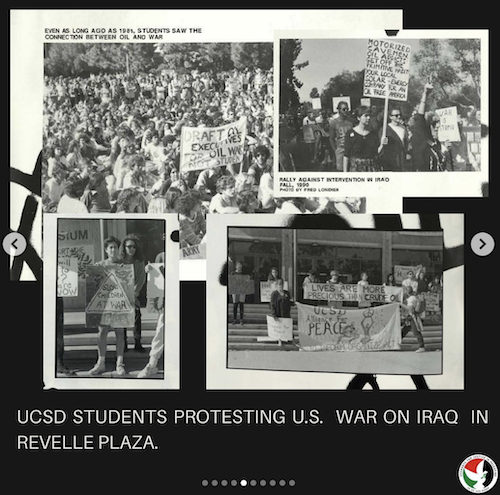
These history lessons were also posted on the Instagram account of Students for Justice in Palestine at UC San Diego, offering a place for additional study of primary sources of the history of student movements at UCSD, for example, see for example, Figure 6.
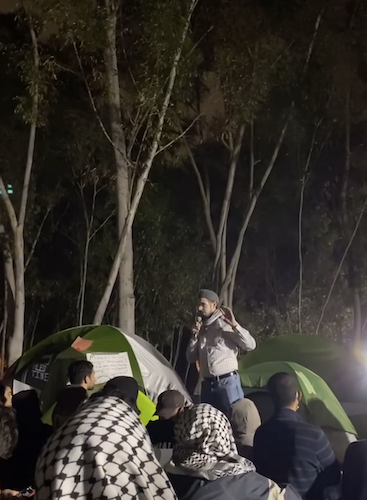
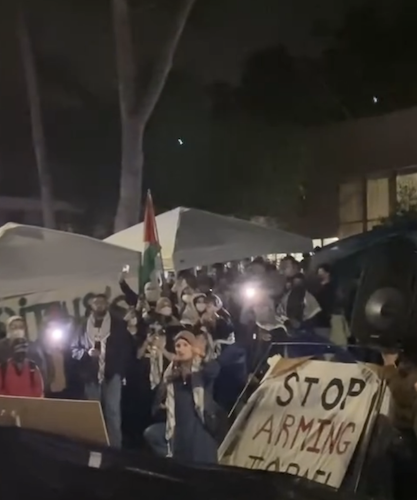
Research was a mainstay at the encampment. Members of the Encampment, under the banner of the UCSD Divest Coalition 69, researched UCSD's complicity in the genocide, focusing both on research that enables the genocide, such as through the Scripps Center for Marine Archeology, the Institute on Global Conflict and Cooperation, the Rady School's US- Israel Center and weapons research at the Jacobs School of Engineering 70, 71 and also on investments that fund the genocide. 72
The Encampment was necessarily a fast-paced and reflective learning environment. Not only did organizers need to create an autonomous Encampment that housed, fed, and cared for the physical and emotional needs of the members of the Encampment, but they also had to carry out research, follow breaking news, train media liaisons, give interviews, make social media posts, make decisions about next steps and carry on with their studies, jobs and other responsibilities, to name just a few. Students had to be able to articulate to people with differing levels of knowledge about the genocide in Palestine, what the Encampment was demanding and why. This required knowledge of the history not only of Palestine, but also of the statistics and political history of the region. They had to attend to and research USCD's investments, financial structure, and complex entanglements with a genocidal state's networks of partnerships and investments in UCSD. All of this was done under the strain of the increasing number of Encampments across the US being violently raided by police.
3) Advocating for Change at UCSD
The context of UCSD’s Gaza Solidarity Encampment, a peaceful student-organized protest, was the genocide of the Palestinian People in Gaza and UCSD’s complicity in it. On May 1, 35,000 people in Gaza had been killed. The deaths, the horrific injuries, the rubblization of homes, businesses, schools, universities and hospitals, the murders of professors, medical professionals and journalists, the denial of water, food and medicines, the incessant buzzing of drones, all of this was live-streamed and documented 24/7 on students phones in heart- wrenching video and images of death, suffering and destruction.
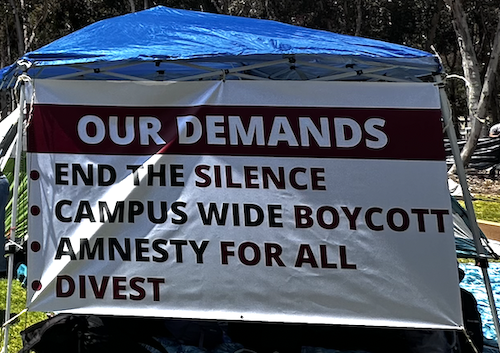
The goals of the Encampment were prominently displayed on a banner "Our Demands" at the east side of the Encampment. The goals of the Encampment addressed UCSD’s complicity in the genocide:
1. End the silence (Affirm Palestinians' right to life and safety, condemn the ongoing genocide in Gaza, and call for the permanent immediate ceasefire);
2. Campus-wide boycott (Permanently sever all institutional ties to Israel and other entities that render our university complicit in the Gaza genocide, including research partnerships with the Israeli Defense Ministry, U.S. Department of Defense, and private defense contractors);
3. Amnesty for all (Ensure amnesty for all those associated with the Gaza solidarity encampment at UCSD, and stop the repression of Palestinian activism on our campus);
4. Divest from death (Immediately divest the University of California's financial holdings from weapons manufacturers and companies that enable and profit from Israeli apartheid, occupation, and genocide. 73
More than two years after the Encampment, and even in the wake of the Islamic Center of San Diego attack and murders 74, the first demand remains unfulfilled and the silence continues. UCSD senior administration has not spoken out in support of its Palestinian, Arab and Muslim students nor has it condemned a genocide that has destroyed all universities in Gaza and murdered more than 100 Palestinian faculty.
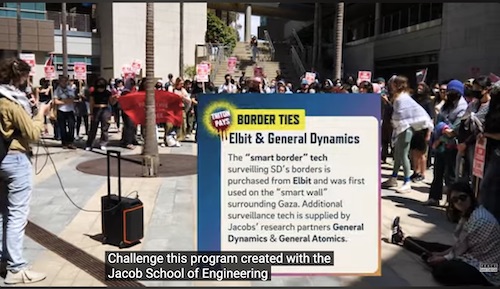
Because the Encampment was cut short by the violent attack ordered by UCSD senior administration, research on UCSD's research that materially and discursively has supported the genocide in Gaza was not shared until the UC-wide strike by graduate student unions that followed the violent Encampment dismantlements at UCLA, UCSD and UCI. The findings were presented in a UCSD Complicity Walking Tour on June 3, 2024. 75 The second demand, a campus-wide boycott, remains unaddressed. Research in support of the genocidal killing machine continues at UCSD, and research ties remain.
Rather than address the third demand asking for amnesty for all, the senior administration has doubled down on their aggressive implementation of the Palestine Exception to Free Speech through the politicization of legal and disciplinary processes, beginning in 2024 and continuing to the present (August, 2026). They advocated that all those arrested at the Encampment on May 6 be criminally charged, but the City Attorney declined to do so. 76 They put all 56 students arrested at the Encampment through lengthy student misconduct procedures in processes that have been characterized as kangaroo courts or show trials. The university presented generic, non-specific identical evidence packets for all the students, and despite excellent pro-bono representation, all but one student was found guilty. 77 Almost two years after the Encampment, the senior administration brought disciplinary charges against two faculty members who stood with their students during the violent police raid on the Encampment. 78 Those processes are still ongoing. Additional disciplinary charges for Palestine advocacy have been brought against both students and faculty, and no charges have been brought against anyone participating in anti-Palestinian advocacy, contributing to a chilling effect on academic discussion of the genocide at UCSD.
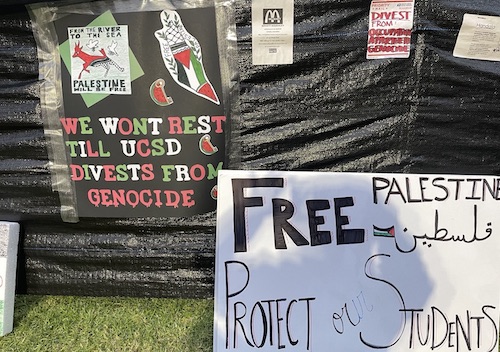
Regarding the fourth demand on divestment, the UC Regents have repeatedly refused to divest from Israel (e.g., 79). In 1986, the UC Regents divested from South Africa because of its implementation of the crime of Apartheid, following intense student pressure. 80 Forty years later, the current UC Regents refuse to divest from Israel for the more serious crime of genocide in Gaza.
UCSD's partnerships with Israeli universities, US Department of Defense contracts, investments in war, and how these make all people unsafe were the topics of many signs, large and small.
Throughout the Encampment students from inside and outside of the Encampment led anti-genocide chants, the most often recited was a simple and righteous demand through call and response: "Free...Free Palestine. Free! Free! Free! Palestine!" Chanting served multiple purposes: to express a collective message, build solidarity, sustain energy and morale, attract public attention, make participation accessible, coordinate collective action, and create memorable narratives. All of the chants distilled the dimensions of the movement for a free Palestine into concise, memorable phrases. These chants communicated the Encampment's demands and values to bystanders, fellow students, the media and decision-makers. For example, "Khosla, Khosla, you can't hide! You are funding genocide!" coveys a clear message that UCSD Chancellor Khosla's administrative decision- making provides the financial backing for and repression of student speech about Israel's continued genocide of the Palestinian people. Similarly, "UCSD, you can't hide, we charge you with genocide!" implicates UCSD's furtive partnerships and investments in Israeli universities and weapons development, is a clear call for justice and will long be associated with UCSD's Encampment.
Students were clear about the goals of the Encampment and UCSD's complicity in genocide as KPBS reported on May 1: "'As a Jewish American student, I stand with the many Jewish, Palestinian and people of all backgrounds that demand divestment from the occupation and genocide of the Palestinian people,' said Rachel, an undergraduate majoring in biological anthropology. 'We are inspired by the Black civil rights movement, the anti-apartheid movement in South Africa, and the Jewish concept of Tikkun Olam — to repair the world — to call for a free Palestine.'" 81
Students who participated in the Encampment protest sacrificed their own time, comfort and safety to draw attention to their heartfelt opposition to the genocide in Gaza and to build solidarity. They sustained their energy and morale with chants like, ""Disclose! Divest! We will not stop, we will not rest!" Beyond these reasons, chants also served to make participation in protest accessible to passersby who could also choose to speak out against the genocide through joining in collective chants: "The people united will never be defeated!"
4) Communal Space/Mutual Aid and Support
The UC San Diego (UCSD) Gaza Solidarity encampment operated as a highly organized, self-sustaining communal ecosystem rooted in the principles of mutual aid. Rather than just acting as a site for physical tents, the student-led coalition structured the space near the
Geisel Library to independently meet the daily physical, medical, educational, and safety needs of its participants. Students were aware that they would need to secure their own safety and care through mutual aid. As reported by ABC 10 News on May 2, one member of the Encampment shared, "'Since we've been out here we've received threats that they'll call SDPD, that they'll review our IDs,' Yasmeen said. 'We want to make sure the students are protected and can exercise their rights.'" 82 Yasmeen said she felt like she has to 'be on her toes' because of how closely school officials and security and police officers are watching.
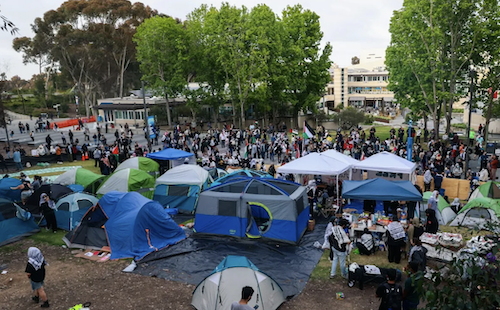
To maintain independence from university infrastructure, organizers established dedicated, fully-stocked resource booths:
● Food and Water Tents: A centralized kitchen area distributed free meals, snacks, and water to anyone inside the Encampment. These supplies were largely replenished by a steady stream of community donations from local San Diego residents and businesses, and supportive faculty members. (Figure 12: 83
● Medical and First-Aid Hubs: The Encampment featured a medical tent staffed by volunteer students and healthcare professionals. It was stocked with basic first-aid kits, over-the-counter medication, hygiene products, and personal protective equipment.
● Sanitation Teams: Dedicated trash and recycling stations were monitored by student volunteers to keep the public area clean and ensure the campsite remained organized and safe.
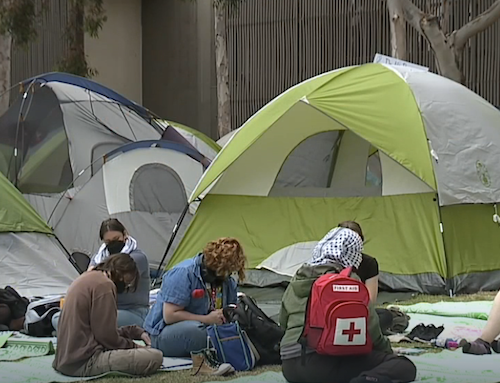
The Encampment implemented autonomous safety protocols. Given that the senior administration fostered hostility toward students who opposed a genocide, members of the Encampment relied on collective internal protocols to keep themselves safe. The Encampment deployed De-escalation and Safety Teams. Student volunteers were assigned to guard the perimeter, teach incoming visitors community guidelines and safety protocols, and practice de-escalation tactics. This ensured that internal community members and participants on the Encampment periphery remained protected from harassment by counter- protesters and administrative staff. Community guidelines were posted and adhered to by all members of the Encampment. The organizing coalition established community behavioral guidelines emphasizing non-violence, cleanliness, mutual respect, and sober participation to preserve the Encampment's focus on peace and solidarity.
The local San Diego community, inspired by the student Encampment, contributed donations including extra blankets for cold nights, and supplies for the well-being of members of the Encampment.
5) Communicating the Pain and Horror of Genocide and The Possibilities for Change
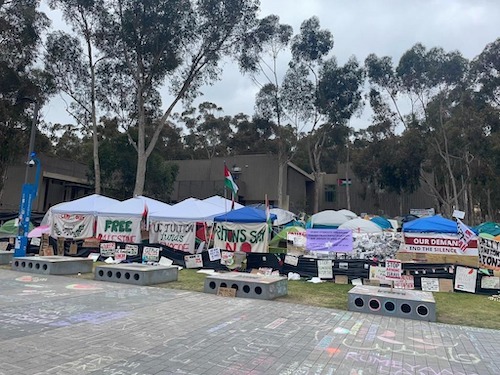
On May 1st and the following days, passersby and onlookers were greeted with the dozens of lovingly designed signs and banners that were placed at the perimeter of the encampment and against tents.
Signs carried clear messages of the deeply held beliefs, some explicitly religious, of the students to end the violence in Gaza. The signs were a living reminder of the hearts and minds of students who had joined a nationwide movement to stop killing and death in Gaza. Their messages reflected a love for all.

Signs made by youth called for a ceasefire (Figure 16).
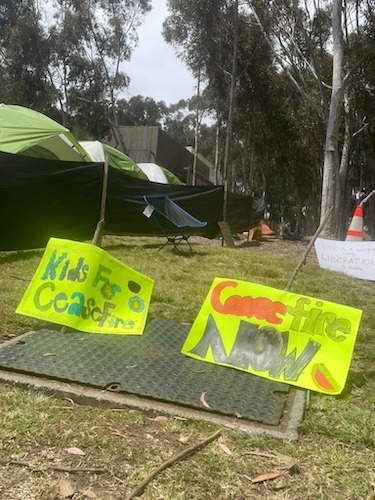
Signs were deeply analytical and named power structures and war profiteering as the root of the genocide: "From Palestine to the Philippines: Stop the US War Machine" (Figure 17).
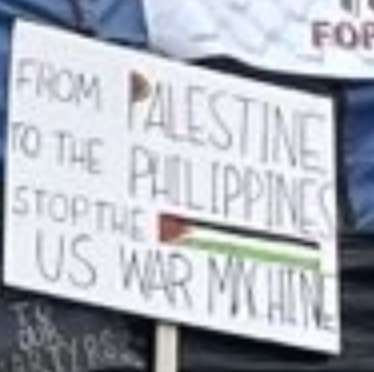
Passersby on Library Walk read signs, took photos of them, and visited the memorial to the infant martyrs murdered by Israel, honored with the placement of small electric candles.
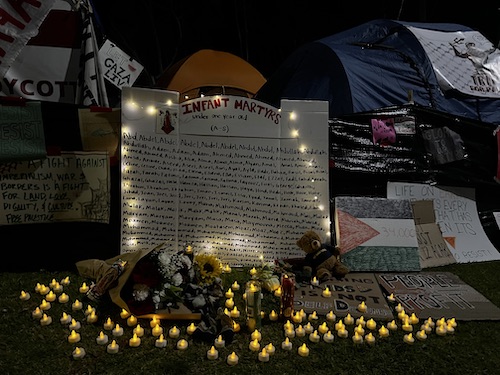
Visitors were observed in contemplation and conversation with one another.
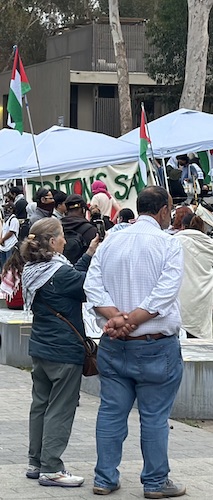
News media came daily to the Encampment to interview and film spokespeople and passersby about the Encampment. 84Helicopters could be heard and were observed hovering over the Encampment, as were drones. Despite harsh reprisals for peaceful protest observed at multiple UC campuses and nationwide, members of the Encampment persisted, given their belief that the genocide merited the risk their constitutionally protected speech might be infringed upon by UCSD senior administration.
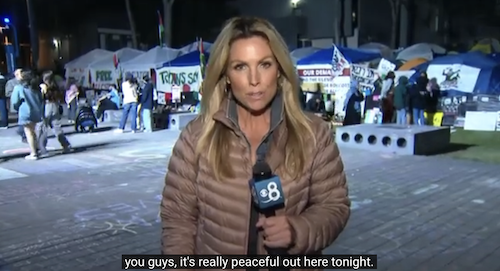
Some media outlets contrasted the violence of the police attack on the Encampment on May 6 with its peaceful nature. For example, Fox 5 News noted "Up until Monday, the encampment had largely remained calm, aside from drawing a group of counter-protestors and health inspectors over the weekend." 85
6) Sharing Diverse Cultural and Religious Traditions
The Encampment was organized through a Palestinian, Arab, Muslim, and Jewish collaboration that drew explicitly on religious and cultural traditions foregrounding justice and freedom from oppression. Throughout the duration of the Encampment, participants, students, faculty, staff, community members, including families and children, shared their diverse cultural and religious traditions, enriching the learning space through an mutual exchange of ideas and deeply held beliefs and practices. The Encampment offered a rare opportunity for the UCSD community to engage in a cultural and religious exchange that was welcomed and welcoming to all. These exchanges included Muslim prayer, a Jewish Shabbat ceremony, Dabka dance, and sharing of food and resources.
Interfaith solidarity served as a core pillar of the UC San Diego Gaza Solidarity Encampment. Organizers intentionally structured the camp as an inclusive space, drawing together a multiracial and interfaith coalition of students, faculty, and local religious leaders.
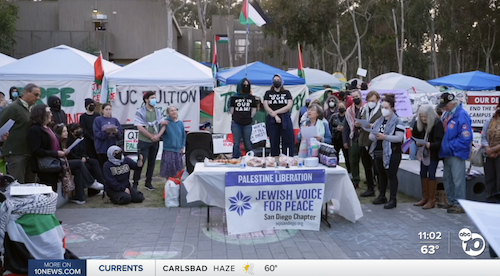
Jewish students from the Encampment, community members and religious leaders held a Shabbat celebration on May 3 in front of the Encampment. ABC 10 News cited one participant who said "I think it says there is a fundamental human rights issue at stake here" and reported, "Jewish community members told ABC 10 News they felt a greater responsibility to show up Friday, to publicly stand against what Israel is doing.
'Showing support as someone who has the oppressor's blood, saying hey, this is wrong,' said Dave Engel. 'We want to take back our culture, and so we will do it here to show solidarity with Gaza,' said Avraham." 86
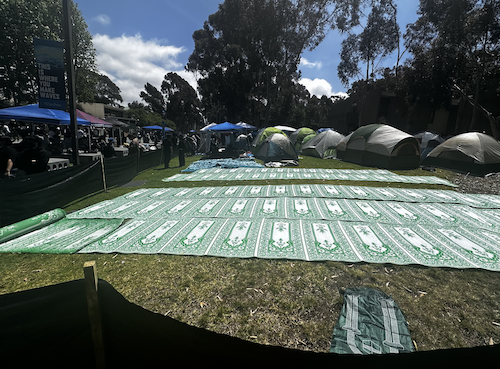
Likewise, Muslim students and participants at the UCSD Gaza Solidarity encampment held congregational and daily prayers— such as Dhuhr, Asr, and evening prayers —on a regular, daily basis as part of the Encampment's routine schedule. Prayers and spiritual gatherings were integrated directly into the daily programming alongside teach-ins and rallies. Prayer spaces were protected in solidarity with vulnerable students. When Muslim students held their daily congregational prayers, non-Muslim peers—including Jewish and secular students—formed protective human chains around them to ensure privacy and security from counter- protestors and exploitative media.
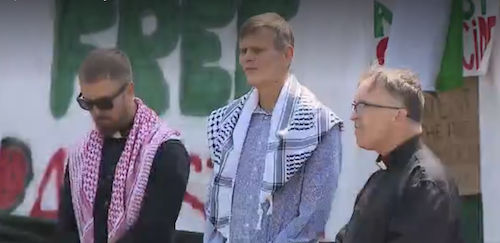
On the third day of the protest, regional faith leaders held a joint press conference and rally. As reported by Fox 5 News, “At this moment I am here to stand in solidarity with our students in this encampment,” said Imam Taha Hassane, Director of the Islamic Center of San Diego. “We are expecting the UCSD administration to respond to them to meet with them and to choose the right route and the right option.” 87
The Encampment featured shared educational and cultural programming. The interior of the Encampment was structured to promote collaborative community building and political education. Through teach-ins and library spaces, faculty and graduate students conducted alternative lectures and lectures open to the public, transforming the camp into a living classroom. Community tables also held literature, educational pamphlets, and zines. Cultural expression was facilitated by the integration of art, collective mourning, and celebrations, such as communal Palestinian Dabke dancing, poetry readings, and shared Shabbat services.
7) Disciplined Organizing Space Under Surveillance and Pressure
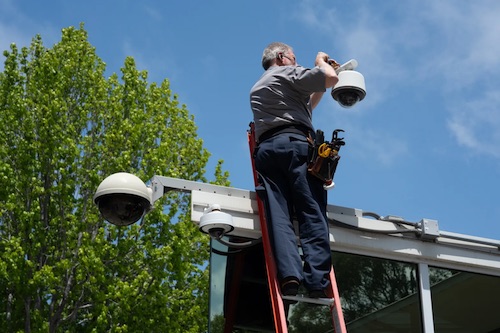
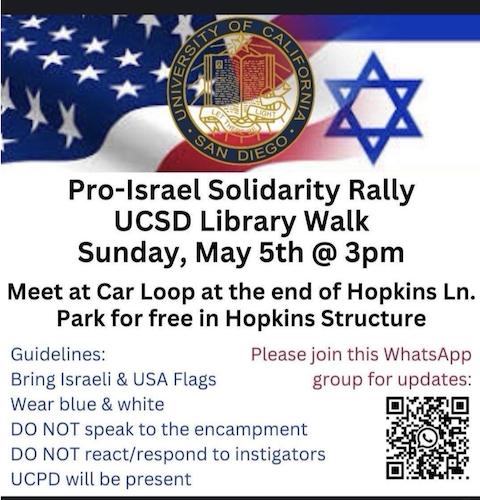
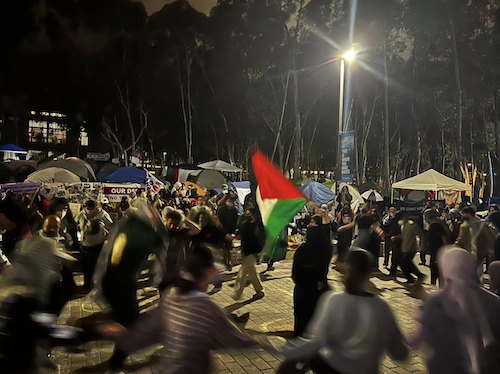
The Encampment was surveilled extensively, both with video cameras 89 and by administrative staff taking notes, and by counter-protesters video-recording and audio-recording at its periphery. The senior administration incited hostility toward the Encampment by describing the Encampment as being dangerous, in violation of rules, disruptive to campus operations, implicitly violent and uncivil (activating anti-Palestinian and anti-Arab racist tropes, and anti-Muslim bigoted tropes – see the section Notes on the Senior Administration’s ‘Fact Sheet’). The Encampment was periodically disrupted by small groups of counter-protesters seeking to provoke Encampment members or initiate confrontations. A large counter-protester rally and march took place on Library Walk in front of the Encampment on May 5. (It is worth considering what the reaction of authorities would have been if pro-Palestinian demonstrators had analogously conducted a rally outside of the Hillel Center at the south end of campus.) Confrontations could be used against the Encampment regardless of the origin of the aggression, given senior administration's consistent biases and political commitments. For example, the UCLA Encampment was cast as violent by the Chair of the UC Board of Regents after it was attacked by vigilante counter-protesters on April 30, 2024.
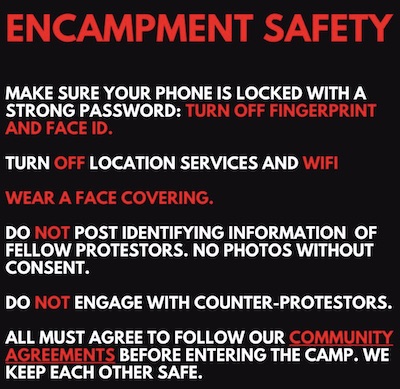
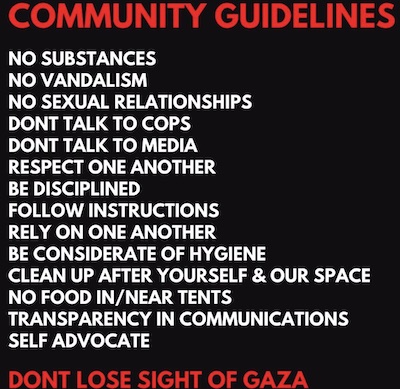
These facts required the Encampment to adopt a disciplined, well-organized and adaptable stance, but at the same time to be open to students, staff, faculty and community members with a very broad range of knowledge and perspectives. That student organizers were able to accomplish organizing a successful, peaceful and safe Encampment with less than two weeks for planning (following the establishment of the first major Encampment at Columbia University on April 17 12b) was nothing short of spectacular. But for the Palestine Exception to Free Speech 44b, UCSD would have showered the organizers with awards for their skill in learning the lessons of history and in putting into practice methods for community-based education and research that they had learned about in their classes. The organizers relied on a largely horizontal organizing model that had been refined over several decades by liberation movements across the globe. 90 They developed detailed demands, thoughtful community guidelines, and protocols for safety and published those on the first day of the Encampment. (In some organizing contexts these would be termed Points of Unity or Community Agreements). The aforementioned guidelines and protocols required all who wished to join to familiarize themselves with those guidelines and protocols. 91, 92 They developed plans for mutual aid within the Encampment, so that all the needs of those present would be provided for. They distributed responsibility for safety, mutual aid, Encampment maintenance, education, research and community engagement among all of the members, so that everyone was invested in the smooth functioning of the Encampment. Such a feat within the hierarchical structures of UCSD would have taken faculty and administrators years of planning and millions of dollars in funding.
Far from the lies told about the Encampment, signs reflected good will and love for all. Some signs were messages to counter-protestors calling for peace and reconciliation to stop "hate" and "blood shed."
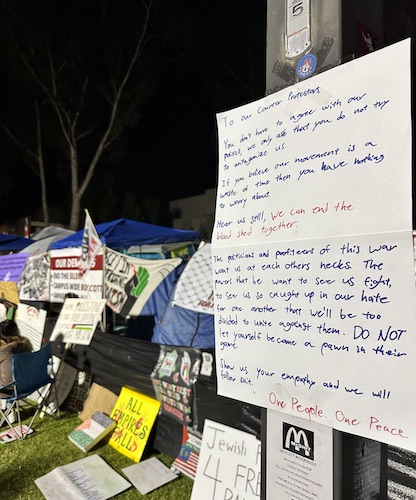
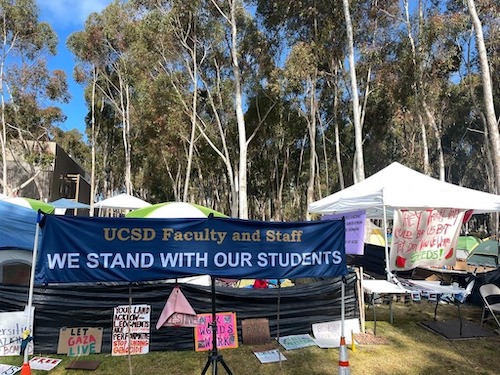
Safety was a theme for students and those faculty who stood by their students' rights to peacefully protest.
Dozens of faculty and staff gathered outside of the Encampment near the sign "UCSD Faculty and Staff WE STAND WITH OUR STUDENTS" to show their support. Faculty were present 24 hours per day throughout the duration of the Encampment.
Chants were especially helpful to members of the Encampment when counter-protestors marched on Library Walk. Members of the Encampment formed a line shoulder to shoulder with their back to the Encampment, leaving Library Walk clear, and chanted "Free Palestine" to sustain themselves as they endured genocide-supporters heckling them.
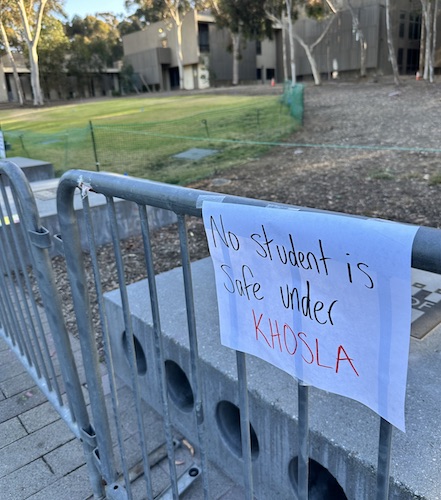
The day after the May 6th violent police raid, arrests and destruction of student property and signs, new student signs appeared showing their understanding of those responsible for complicity in genocide, and named UCSD Chancellor Khosla as the architect of their own vulnerability to danger.
After the police raid on the Encampment, signs reflected the resolve of students in the wake of an attack directed by UCSD senior administration: "Students for Peace, attacked by the police. Your tuition funds this."

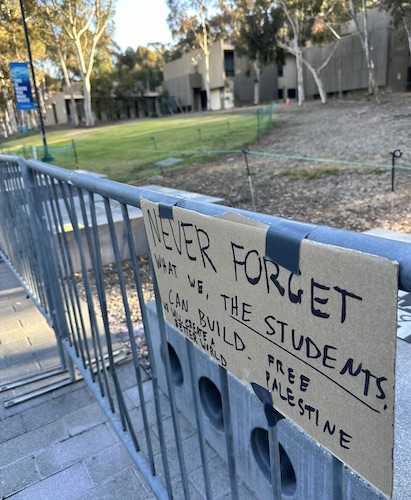
Another sign on May 7, 2026 reminds passersby to "Never forget what we, the students can build. We will create a better world. Free Palestine."
Return to Methods ||| Advance to Timeline
- 62
ABC 10 News (2024) WATCH LIVE: UCSD Encampment, Youtube video, May 1. https://www.youtube.com/watch?v=VVlYFYuKUHE
- 63
CBS 8 San Diego (2024) UCSD Pro-Palestinian Encampment | Day 2, Youtube video, May 2. https://www.youtube.com/watch?v=uyw1uhG2W9o
- 64
UCSD Faculty (2024) Faculty Testimony on the UCSD Gaza Encampment, May 6. https://docs.google.com/document/d/1aHgGjddDhgE0-IDxsTUf1Nk_n1F3n0nhF2v…
- 65
UC San Diego (2026) UC San Diego Principles of Community. https://ucsd.edu/about/principles.html
- 67
Students for Justice in Palestine at UC San Diego (2024) Imam Tom Night 2, Instagram, May 3. https://www.instagram.com/p/C6hXQ_XuqYr/
- 68
Students for Justice in Palestine at UC San Diego (2024) Linda Sarsour Night One, Instagram, May 1. https://www.instagram.com/p/C6c-lMsrWtG/
- 69
UCSD Divest Coalition (2024) Linktree. https://linktr.ee/ucsd.divest
- 70
UCSD Divest Coalition (2024) UCSD's Complicity: A Walking Tour Brochure. https://ugc.production.linktr.ee/d3fd4ddf-fcb2-44a7-8e39-ded8d8da3f97_C…
- 71
UCSD Divest Coalition (2024) UCSD's Complicity: A Virtual Tour. https://ion.cesium.com/stories/viewer/?id=59db8cdc-fd53-4c12-a1a1-6b56e…
- 72
UC Divest Coalition (2024) Boycott Divestment and Sanctions at the University of California. https://docs.google.com/presentation/d/e/2PACX-1vQHFdeJaVJkEo2r4r6bGlYa…
- 73
Students for Justice in Palestine at UC San Diego (2024) Our Demands, Instagram, May 1. https://www.instagram.com/p/C6b7VunPv59/?img_index=3
- 74
Islamic Center of San Diego (2026) ICSD Victim and Family Support Fund. https://goodbricks.org/campaign/icsd.org/official-icsd-victim---family-…
- 75
Peace San Diego (2024) UCSD's Complicity in Genocide Tour, Youtube video, June 3. https://www.youtube.com/watch?v=oTbOQ0A5EuY
- 76
Donald H Harrison (2024) City Attorney Declines Charges for 64 Anti-Israel Protesters Arrested at UCSD, Prompting Backlash, Times of San Diego, November 1. https://timesofsandiego.com/crime/2024/11/01/city-attorney-declines-cha…
- 77
Katie Hyson and Matthew Bowler (2024) 'It’s David versus Goliath': UCSD Student Protestors Challenge Discipline Charges, KPBS, October 21. https://www.kpbs.org/news/education/2024/10/21/its-david-versus-goliath…
- 78
UCSD Faculty for Justice in Palestine and Council on American Islamic Relations California (2026) Press Release - UCSD Designated a Hostile Campus: Administration Doubles Down on New Recognition, April 2. https://cryptpad.fr/file/#/2/file/VO0m-ipf-55GCmr-OCw3nCOY/
- 79
UC Office of the President (2024) University of California Statement on Divestment, April 26. https://www.universityofcalifornia.edu/press-room/university-california…
- 80
One Bold Idea (2018) How Students Helped End Apartheid. https://www.universityofcalifornia.edu/news/how-students-helped-end-apa…
- 81
M.G. Perez, Matthew Bowler and Bennett Lacy (2024) UCSD Students Establish Pro- Palestinian Encampment on Campus, KPBS, May1. https://www.kpbs.org/news/education/2024/05/01/ucsd-students-establish-…
- 82
Dani Miskell (2024) As Encampments Dismantle Across US, UC San Diego Stands Their Ground, ABC 10 News, May 2. https://www.10news.com/as-encampments-dismantle-across-the-u-s-ucsd-sta…
- 83
Debbie L. Sklar (2024) UCSD Students Establish Encampment, USD Students Lead Gaza Memorial, Times of San Diego, May 1. https://timesofsandiego.com/politics/2024/05/01/ucsd-students-establish…
- 84
CBS San Diego (2024) UCSD Encampment Says They Are Focused on Peace, Youtube Video, May 3. https://www.youtube.com/watch?v=6W3VFY0HKjc&t=20
- 85
Danielle Dawson (2024) ‘Normal Operations’ Resume at UC San Diego After Dozens of Protestors Arrested, Fox 5 News, May 7. https://fox5sandiego.com/news/local-news/normal-operations-resume-at-uc…
- 86
Laura Acevedo (2024) Shabbat Celebration at UCSD Gaza Solidarity Encampment, ABC 10 News, May 3. https://www.10news.com/news/local-news/shabbat-celebration-at-the-ucsd-…
- 87
Danielle Dawson and Christelle Koumoué (2024) 'Gaza Solidarity' Encampment at UC San Diego Enters Third Day, Fox News San Diego, May 4. https://fox5sandiego.com/news/local-news/gaza-solidarity-encampment-at-…
- 89
Philip Salata (2024) UCSD Protesters Pitch Camp in Nationwide Movement for Palestine, inewsource, May 2. https://inewsource.org/2024/05/02/ucsd-students-protest-israel-divestme…
- 12b
NYC Palestinian Youth Movement (2024) Columbia has Continually Refused to Listen to the Student Body When We Demand that They Divest from the Ongoing Genocide in Gaza, Instagram, April 17. https://www.instagram.com/p/C54bO1gNkqq/?hl=en
- 44b
Palestine Legal and The Center for Constitutional Rights (2015) The Palestine Exception to Free SpeechL A Movement Under Attack in the US. https://palestinelegal.org/the-palestine-exception
- 90
David Graeber (2002) The New Anarchists, New Left Review, 13(6), 61-73. https://theanarchistlibrary.org/library/david-graeber-the-new-anarchists
- 91
Students for Justice in Palestine at UC San Diego (2024) Encampment Safety, Instagram, May 1. https://www.instagram.com/p/C6b7VunPv59/?img_index=4
- 92
Students for Justice in Palestine at UC San Diego (2024) Community Guidelines, Instagram, May 1. https://www.instagram.com/p/C6b7VunPv59/?img_index=6